Death, be not proud (Holy Sonnet 10)
by John Donne
Death, be not proud, though some have called thee
Mighty and dreadful, for thou are not so;
For those whom thou think'st thou dost overthrow
Die not, poor Death, nor yet canst thou kill me.
From rest and sleep, which but thy pictures be,
Much pleasure; then from thee much more must flow,
And soonest our best men with thee do go,
Rest of their bones, and soul's delivery.
Thou'art slave to fate, chance, kings, and desperate men,
And dost with poison, war, and sickness dwell,
And poppy'or charms can make us sleep as well
And better than thy stroke; why swell'st thou then?
One short sleep past, we wake eternally,
And death shall be no more; Death, thou shalt die.
Showing posts with label John Donne. Show all posts
Showing posts with label John Donne. Show all posts
Friday, October 19, 2012


Sunday, June 24, 2012
John Donne on distractions
I have the wonderful privilege of preaching this morning at my church, Church In The Oaks, while sharing the pulpit with good friend Rich Cherry. We are preaching on 2 Timothy 2:1-9 which is as follows:
You then, my child, be strengthened by the grace that is in Christ Jesus, and what you have heard from me in the presence of many witnesses entrust to faithful men who will be able to teach others also. Share in suffering as a good soldier of Christ Jesus. No soldier gets entangled in civilian pursuits, since his aim is to please the one who enlisted him. An athlete is not crowned unless he competes according to the rules. It is the hard-working farmer who ought to have the first share of the crops. Think over what I say, for the Lord will give you understanding in everything.
As I discuss the analogy of a soldier refraining from entanglement and focusing on pleasing his commander, I'll share this excerpt from John Donne as it occurred in his sermon entitled The Divided Mind.Remember Jesus Christ, risen from the dead, the offspring of David, as preached in my gospel, for which I am suffering, bound with chains as a criminal. But the word of God is not bound!
We are easily distracted; our attention and devotion is diverted and side-tracked by the momentous and the mundane. But, perseverance in the midst of faith-confirming suffering necessitates a single-minded beholding of the gospel, of the cross, of Christ, of God. Pray with us that God would help us keep him as proverbial apple of our eye.I throw myself down in my chamber, and I call in, and invite God, and his angels thither, and when they are there, I neglect God and his angels, for the noise of a fly, for the rattling of a coach, for the whining of a door; I talk on, in the same posture of praying; eyes lifted up; knees bowed down; as though I prayed to God; and, if God, or his angels should ask me, when I thought last of God in that prayer, I cannot tell: sometimes I find that I had forgot what I was about, but when I began to forget it, I cannot tell. A memory of yesterday's pleasures, a fear of tomorrow's dangers, a straw under my knee, a noise in mine ear, a light in mine eye, an anything, a nothing, a fancy, a chimera in my brain, troubles me in my prayer.
Sunday, December 25, 2011
Donne, Piper, and Oliphint on Immensity
A Christmas Day tweet by John Piper, who you can follow at @JohnPiper, gave me direction for today's post. Piper tweeted the following:
Though I do not know the context of this quote, it clearly points to the Incarnation of Christ. And I don't know a whole lot about Donne, but I think I can guess at a few things about this quote. The word immensity is worth some consideration. Many of us would see in this word nothing more than a synonym of the word "big". However, immensity is a theological term that has a specific meaning in regards to theology proper. My guess is that Donne, a member of the clergy, was using the word in its technical sense. K. Scott Oliphint, in his book of the year (according to me), God With Us, explains,
Thus, the word immensity characterizes God as intrinsically immeasurable which points us toward the fact that God is everywhere. Keep in mind, however, that God is not everywhere like air on earth. He is not spread thinly across the whole expanse of creation. Rather, he is "completely present everywhere. There is, therefore, a ubiquity of God's essence in which he is always and everywhere wholly and completely present." (81)
Thus, Donne was saying something more profound than there is someone really big in Mary's womb. He was articulating something more important than a figurative reference to Mary's baby being someone who would do something "big". He was pointing to a paradox of the Incarnation; the God who is immense-he is everywhere present in all of his being-has taken on flesh and now resides in a woman's womb. In using the word immensity, Donne draws our attention to the Son of God who took on a human nature and took on human flesh. Donne directs our grateful gaze to the God who condescended to save us. This is a wonderful, though somewhat mysterious, truth that we rightly focus on at this time of year.
Take some time to marvel, along with Donne and Piper and Oliphint, at the second person of the Trinity who became a man so that he might rescue, redeem, and reconcile his people.
"Immensity cloystered in thy deare wombe." John Donne
Though I do not know the context of this quote, it clearly points to the Incarnation of Christ. And I don't know a whole lot about Donne, but I think I can guess at a few things about this quote. The word immensity is worth some consideration. Many of us would see in this word nothing more than a synonym of the word "big". However, immensity is a theological term that has a specific meaning in regards to theology proper. My guess is that Donne, a member of the clergy, was using the word in its technical sense. K. Scott Oliphint, in his book of the year (according to me), God With Us, explains,
Given God's independence, it follows that he is not limited by anything, nor is he to abide by the boundaries of creation. One way to articulate this truth is to affirm that God is infinite. In line with traditional terminology, we can discuss God's infinity under two primary headings: eternity and immensity ... In terms of God's relationship to space, immensity is a good word to use. It comes from the Latin immensus, which means immeasurable. This is the best way to think about God's "where-ness." (71-80)
Thus, Donne was saying something more profound than there is someone really big in Mary's womb. He was articulating something more important than a figurative reference to Mary's baby being someone who would do something "big". He was pointing to a paradox of the Incarnation; the God who is immense-he is everywhere present in all of his being-has taken on flesh and now resides in a woman's womb. In using the word immensity, Donne draws our attention to the Son of God who took on a human nature and took on human flesh. Donne directs our grateful gaze to the God who condescended to save us. This is a wonderful, though somewhat mysterious, truth that we rightly focus on at this time of year.
Take some time to marvel, along with Donne and Piper and Oliphint, at the second person of the Trinity who became a man so that he might rescue, redeem, and reconcile his people.
Sunday, November 29, 2009
John Donne: Holy Sonnets XV
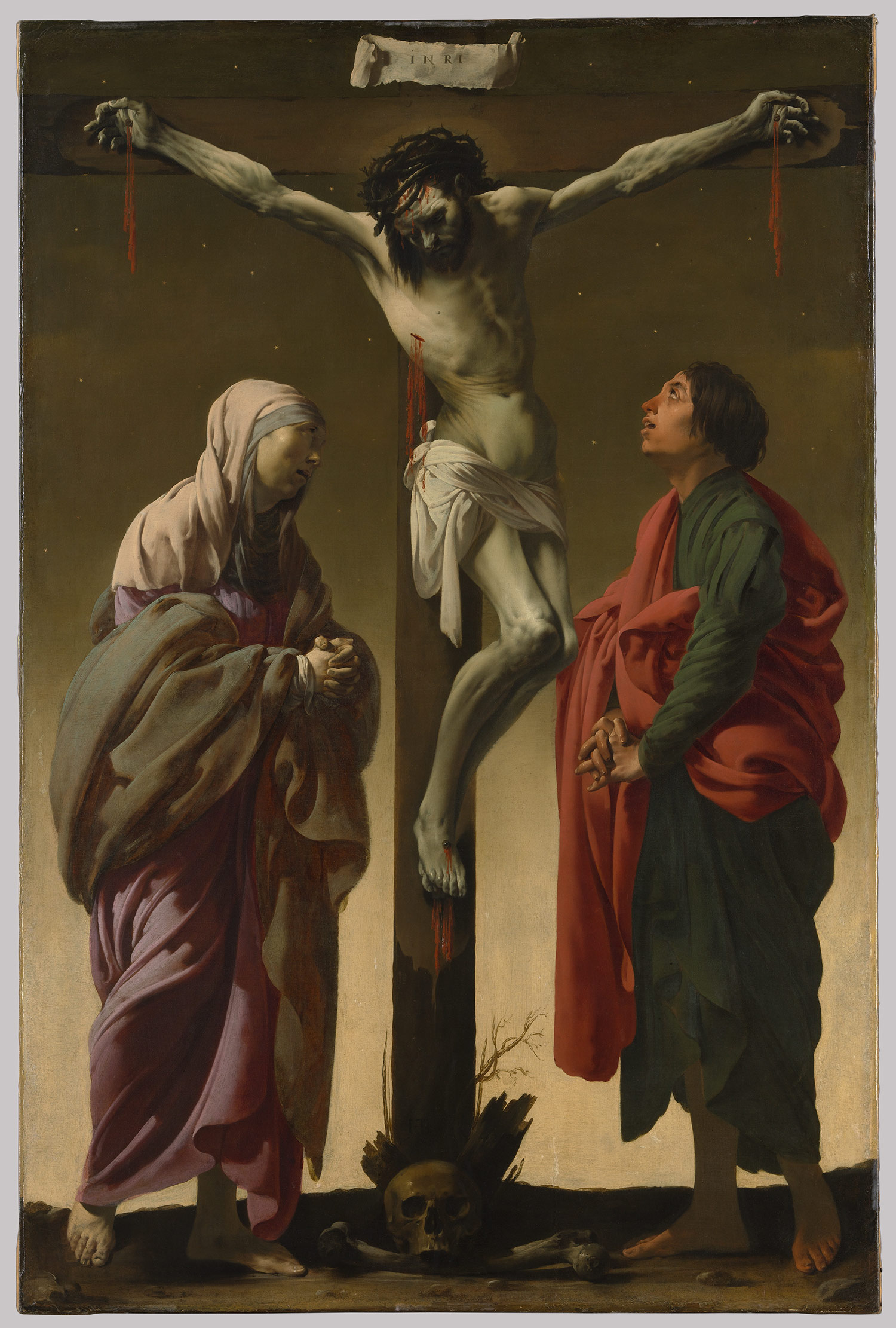
HOLY SONNETS.
XV.
Wilt thou love God as he thee ? then digest,
My soul, this wholesome meditation,
How God the Spirit, by angels waited on
In heaven, doth make His temple in thy breast.
The Father having begot a Son most blest,
And still begetting—for he ne'er begun—
Hath deign'd to choose thee by adoption,
Co-heir to His glory, and Sabbath' endless rest.
And as a robb'd man, which by search doth find
His stolen stuff sold, must lose or buy it again,
The Sun of glory came down, and was slain,
Us whom He had made, and Satan stole, to unbind.
'Twas much, that man was made like God before,
But, that God should be made like man, much more.
John Donne
Subscribe to:
Posts (Atom)