Showing posts with label penal substitution. Show all posts

Sunday, April 20, 2014

Lawrence on Penal Substitution

With Easter upon us and churches everywhere preaching the death and resurrection of Christ, the cries of injustice and divine child abuse ring out from liberal Christians everywhere. Below is a quote speaking to the truth of penal substitution; the truth of the gospel of Jesus Christ. 

From chapter 6 of It is Well, written by Michael Lawrence:

Penal substitution does not turn God into a cosmic child abuser. It does not reduce Christ to the passive victim of some divine injustice. It does not put the Trinity against itself. No, in the God-forsakenness of Christ on the cross, the love of God and the justice of God are revealed on our behalf. United in purpose, Father and Son act in concert to save God's people. The sinless Son of God bears our sin, and then God pours out the wrath that our sin deserves, and Jesus the Son endures it so that we, who deserve the wrath, might never encounter it. This is the gospel, the good news of the cross, and it calls is to forsake our sin, to turn away from it and embrace Christ, the forsaken one, so that we may not be forsaken.

Christian, what sin are you cherishing these days that you should not be? What sin do you feel like you just can't forsake? What obedience do you feel like you just can't make? Oh, Christian, remember that Christ was forsaken for you. In light of that, what can you not forsake? Friend, if you're not a Christian, consider what small thing it is to forsake your sin, to forsake the whole world even, in exchange for never being forsaken by God.

Monday, January 7, 2013

Performance and Perfection

From Gospel-Centered Discipleship:
Whenever we replace Jesus with another lord, we displace the gospel from the center of our discipleship. We substitute Jesus's perfect performance for our imperfect performance, which will always fail.  The gospel reminds us that our approval before God rests, not on our performance but on the performance of Jesus in his perfect life, death, and resurrection. Religious performance deceives us by saying: "Impress God and he will approve of you." The truth of the goepl, however, says: "You don't have to impress God because Jesus has impressed him for you." (71)

Substitution in the atonement as understood by evangelicals is a beautiful doctrine. But when the substitution you're practicing is one in which you substitute your good works in place of Christ's, to quote the younger generation, "you're doing it wrong."

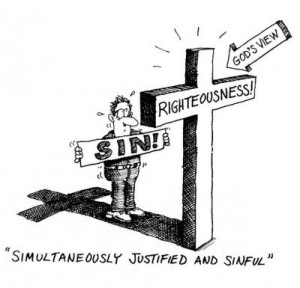
Substitution in the proper sense is necessary precisely because our own good works are not sufficient to assuage God's wrath and make him pleased with us. Thus, Christ became sin for us and suffered the penalty due us, that we might be reconciled to God. Our sin was imputed to him; his righteousness was imputed to us.

Thursday, June 28, 2012

Atonement in 1 Peter

Dan G. McCartney, in his chapter investigating atonement in the biblical books James, Peter, and Jude, from The Glory of the Atonement, discusses the reconciling work of Christ in 1 Peter:

To accomplish the goal of helping the believer identify with the Lord, 1 Peter develops at least five different types of metaphor or imagery to depict and elaborate on the atoning work of Christ, a work that both makes that identification possible and real, and motivates the believer to live accordingly. These are:

1. Servant imagery, especially the notion of representative or substitutionary obedience.

2. Cultic imagery, which uses the language of ritual cleansing, sacrifice and the sacrificial system of the OT.

3. Marketplace imagery, or the idea of purchasing or buying back out of hock and particularly the notion of purchase out of slavery.

4. Conflict resolution imagery, which speaks of reconciling of enemies or propitiating the anger of the offended party.

5. Military imagery, the notion of monomachy or representative single combat as warfare.

What links all of these is the idea of substitution or representation, where one party or thing stands in place of, or works on behalf of, another. 

(Nicole, Roger R., Charles E. Hill, and Frank A. James. The Glory of the Atonement: Biblical, Historical & Practical Perspectives : Essays in Honor of Roger Nicole. Downers Grove, IL: InterVarsity, 2004. Print. 180)


Monday, June 18, 2012

Substitution and Sacrifices explained by Dr. Jim Hamilton


As I blog through Dr. Jim Hamilton’s momentous and memorable biblical theology called God’s Glory in Salvation through Judgment, I come to an important explanation focused on the sacrifices of the Old Testament Levitical system. The OT sacrifices, and how they relate to us as New Testament believers, is something I have often wrestled with and, in some respects, continue to wrestle with. This excerpt from Hamilton’s book is very helpful:

The substitution seen in both the sacrifice of the ram in place of Isaac and the Passover lamb in place of the firstborn of Israel is also reiterated in the Levitical system. Wenham writes, “In some degree substitution seems to form part of the theology of all the sacrifices.” The worshiper places his hand on the head of the sacrificial animal (e.g., Lev. 1:4). The description of the Day of Atonement ritual in Leviticus 16 adds that when the high priest places his hands on the head of the animal, he is to confess the sins of the people over the animal (16:21), and this seems to make explicit what is implicit elsewhere. As Wenham writes, “In sacrifice it appears that the worshiper identifies himself with the animal he offers. What he does to the animal, he does symbolically to himself. The death of the animal portrays the death of himself.” The substitute is judged on behalf of the worshiper. The transfer of guilt from the worshiper to the sacrificial beast, and then the death of the beast, cleanses the worshiper of sin. The blood of the beast atones for the soul of the worshiper (Lev. 17:11). Kiuchi writes, “The offerer is viewed as the object of the Lord’s wrath to varying the degrees, and the offerings symbolize the offer appeasing the Lord’s wrath.” The worshipers are saved by faith through the judgment that falls on the sacrifice. God is glorified in salvation through judgment. (110-1)

This passage not only helps support Hamilton’s premise that the central and unifying theme of the Bible is God’s glory in salvation through judgment, but it is also crucial for understanding the sacrifice that Christ made on Calvary. The Levitical sacrifices are a shadow of Christ’s sacrifices and they point to the Son of God becoming our substitute and propitiating God’s wrath and cleansing us from sin. As God’s elect, he identifies us with himself in his sacrifice; he, as our substitute, is judged on our behalf.

These types of discussions are imperative if we are to understand the concept of penal substitution and Hamilton’s elucidating of the OT sacrifices is a welcome voice.

Monday, June 11, 2012

The Apostolic Preaching of the Cross

The following are excerpts from the concluding chapter of Leon Morris' stellar work on the atonement entitled The Apostolic Preaching of the Cross:
  • Something happened on Calvary quite objective to man, and it is because of this we can have the completest assurance of our salvation. In the last resort it depends on what God has done, and not upon some effect of that action upon the human heart (which is not to deny that there is such an effect, and that it is important). (299)
  • The salvation which Christ effects is not thought of as brought about with effortless ease. On the contrary, it is purchased at great cost, at the price of His blood. There cannot be the slightest doubt that the New Testament writers thought of redemption as an objective thing, as a process whereby Christ paid the price which brought them salvation. The idea that this means no more than that His example inspired them to be better men
  • There is very little place for human activity in this way of viewing Calvary, and once again we see that atonement is essentially something wrought for, rather than in, man. (300)
  • On the contrary, sin calls forth the implacable hostility of His holy nature, and until something is done about it this puts the sinner in an unenviable position. (301)
  • First may we go back to a statement of James Denney: 'God condones nothing: His mercy itself is of an absolute integrity. He is a righteous God, even in justifying the ungodly; and the propitiation He sets forth in Christ Jesus, dying in His sinlessness the death of the sinful, is the key to the mystery. Once more, is not the word which spontaneously rises to our lips to express this the word substitution?' In these words Denney reminds us of a fact which we must always bear in mind in dealing with the atonement, namely that the forgiveness sinners receive is not at the expense of ignoring sin's consequences. 'God condones nothing', and we must not theorize as though He has become indifferent to the wages of sin. While admittedly it raises problems, substitution does emphasize this aspect of atonement. Alternative concepts do not always do so. (302-3)
  • At any rate when we speak of substitution in connection with His death, we should bear in mind that the substitution which results is not the substitution of a casual stranger, but of one who stands in the closest possible relationship with those for whom He died. (303)

Friday, May 18, 2012

Is penal substitution just? Leon Morris thinks so.

How does the idea of Christ suffering and dying on our behalf, taking our place and becoming a sin for us, correspond with our perception of justice. Most would say that someone being punished on behalf of another is not just at all. Leon Morris addresses this issue in this excerpt from The Apostolic Preaching of the Cross.

It is objected to this interpretation that the bearing of penalty by one in the place of another is not really just, so that when Christ suffers for us it is not a matter of fulfilling legal requirements. There is some force in this objection, and there would be more if we were dealing with a human law. But the fact is that we are not. The law in question is the law of God's holy nature, and that nature is merciful as well as just. Thus God's justice, while it is not capricious but works by the method of law, is a justice which finds a large place for mercy and is not hard, bare, and legalistic. At any rate, whether our legal categories can find a place for mercy or not, those of the Bible can and do ... neither justice nor mercy must be whittled down; but neither must they be separated.

(Morris, Leon. The Apostolic Preaching of the Cross. Grand Rapids: Eerdmans, 1965. Print. 280)

Thursday, March 15, 2012

Leon Morris on Redemption


I have recently finished Leon Morris' powerful book on atonement titled The Apostolic Preaching of the Cross. Morris studies and evaluates the many-faceted approach to atonement that the apostles demarcate in the Bible. Obviously, one of the concepts he must deal with is that of redemption. After a thorough treatment of this atonement metaphor, Morris concludes the subject with a consideration of three aspects of redemption that were particularly in view in the apostles' writings:
  1. The state of sin out of which man is to be redeemed – "It is a basic tenet of biblical theology that man is completely unable to grapple with the position created by the fact of his sin, and the redemption passages must be interpreted in light of this context." (61)
  2. The price which is paid – "When the New Testament speaks of our redemption … it means that Christ has paid the price of our redemption. To the extent that the price paid must be adequate for the purchase in question this indicates … a substitution." (61)
  3. The resultant state of the believer – "In the Scripture we see the price paid, the curse borne, in order that those who are redeemed should be brought into the liberty which may paradoxically be called slavery to God. The whole point of this redemption is that sin may no longer have dominion; the redeemed are saved to do the will of their Master." (62)

Tuesday, January 24, 2012

Substitute and representative

Christ's salvific work is staggering in its scope. What He came to do can be simplified; He saved us. But it can also be studied and appreciated inexhaustibly.The grandeur of the life He lived, His birth, His death, His resurrection, and all that is incorporated in the works of Christ is a glory-filled investigation that will never end.

Robert Peterson, in his book Salvation Accomplished by the Son, puts the works of Christ on display for readers to marvel at. The study of Christ quickly transforms into the worship of Christ for his deeds are remarkable.

In this excerpt from his book, Peterson informs that Christ's work is both as a representative and a substitute. He is considering one of the most notable passages from Mark found in the tenth chapter:

For even the Son of Man came not to be served but to serve, and to give his life as a ransom for many.” (Mark 10:45 ESV)

Peterson writes:

Christ redeems as both representative and substitute. He is representative because he is “the man Christ Jesus.” He became a member of the human race to function as Mediator between God and human beings. It is possible that the preposition anti on the front of “ransom” has its classical meaning of “on behalf of.” If so, then it also indicates Christ’s representation of his people before God. The preposition in “a ransom for all” clearly communicates substitution.

Tuesday, August 25, 2009

Reconciliation presupposes somebody is mad at me!

From the 9Marks Blog comes this excerpt from an article by Greg Gilbert:

I’m not going to make a sustained case for penal substitutionary atonement here. I and others have done that elsewhere, over and over and over again. I will, however, assert (again) that penal substitution is not just one more image of the cross among many, from which buffet we may pick and choose depending on what we think will communicate best at any given moment. It is, rather, the underlying reality upon which all the other images depend and are built. So, you say you prefer to talk about the cross in terms of reconciliation instead of penal substitution? Great. All I ask is that you be honest about it and trace that image all the way down. Why, for starters, is reconciliation needed in the first place? Don't tell me you can avoid talking about anger by talking about reconciliation---reconciliation presupposes that somebody is mad at somebody else. So then, is reconciliation needed because we are angry at God, or is it because God is angry at us? And exactly how is reconciliation with an angry God effected at the cross? Is it by something other than Jesus taking the wrath that was owed to us, becoming a curse for us, the just dying for the unjust? You see? You can talk about “the Bible looking at the cross from a multiplicity of perspectives” all you want, but all those perspectives, when you trace them down, come right back to Jesus taking the punishment his people deserved—that is, to penal substitution. And if you argue for something short of that, you are missing the point of the cross, and therefore of the gospel, entirely. (Of course you can—and people have—simply made up a few perspectives that don’t trace back down to penal substitution. But that’s beside the point. We’re talking about biblical images here.)


Read the entire article here. Really, read it!