As a matter of fact, according to a Reformed theological context, we simply do not have the option of arguing for essential change in God. Nor do we have the option of arguing that God's control over creation is such that the decisions and actions that his human creatures take are all related to his decree in such a way as to be absolutely necessary. Nor do we have the option of maintaining that, since God ordains whatever comes to pass, our decisions and actions are not free or responsible. (Oliphint, K. Scott. Reasons [for Faith]: Philosophy in the Service of Theology. Phillipsburg, NJ: P&R Pub., 2006. Print. 303)
Showing posts with label sovereignty. Show all posts
Showing posts with label sovereignty. Show all posts
Friday, February 1, 2013
God's sovereignty and human responsibility


Wednesday, January 16, 2013
Whenever He decides to hold it
From All The Pretty Horses by Cormac McCarthy:
Cormac McCarthy, author of The Road, Blood Meridian and No Country For Old Men, is a writer that I enjoy to read. His style is interesting; minimal punctuation coupled with brilliant vivid description and poignant dialogue. He has written 10 novels which have variously several awards and prizes.
Of his ten novels, I have read five: The Road, Blood Meridian, All The Pretty Horses, The Crossing, and Cities of the Plain. Throughout these novels, as in the quote above, McCarthy uses various characters to suggest that behind all the events of history, often chaotic and full of despair in his novels, there stands a sovereign God. I have no reason to believe that McCarthy us a Christian, but this theme of a sovereign God is one of the unifying threads of the books of his that I have consumed.
In the quote above, the protagonist John Grady Cole recognizes two aspects of God's sovereignty. First, he hints at a sovereign God by suggesting there will be a judgment. There will be a reckoning. And who else could call all people to account except One who is sovereign over all people and all things. Second, the character emphasizes this point by indicating the Judgment Day will occur when God decides it will occur. God is sovereign over time, present, future, and history.
In the novels of McCarthy that I have read, the author promotes through his characters some type of meticulous, divine sovereignty that also entails humans with free will who are held responsible for their choices. This, in my opinion, is closer to the truth than views espoused by many Christians.
You think there’ll be a day when the sun wont rise?
Yeah, said John Grady. Judgment day.
When you think that’ll be?
Whenever He decides to hold it.
Cormac McCarthy, author of The Road, Blood Meridian and No Country For Old Men, is a writer that I enjoy to read. His style is interesting; minimal punctuation coupled with brilliant vivid description and poignant dialogue. He has written 10 novels which have variously several awards and prizes.
Of his ten novels, I have read five: The Road, Blood Meridian, All The Pretty Horses, The Crossing, and Cities of the Plain. Throughout these novels, as in the quote above, McCarthy uses various characters to suggest that behind all the events of history, often chaotic and full of despair in his novels, there stands a sovereign God. I have no reason to believe that McCarthy us a Christian, but this theme of a sovereign God is one of the unifying threads of the books of his that I have consumed.
In the quote above, the protagonist John Grady Cole recognizes two aspects of God's sovereignty. First, he hints at a sovereign God by suggesting there will be a judgment. There will be a reckoning. And who else could call all people to account except One who is sovereign over all people and all things. Second, the character emphasizes this point by indicating the Judgment Day will occur when God decides it will occur. God is sovereign over time, present, future, and history.
In the novels of McCarthy that I have read, the author promotes through his characters some type of meticulous, divine sovereignty that also entails humans with free will who are held responsible for their choices. This, in my opinion, is closer to the truth than views espoused by many Christians.
Thursday, November 8, 2012
Does God really repent? "Yes" says Oliphint
I can't stress enough how helpful I find the writings of Professor Scott Oliphint. His books have been very formative in my understanding of God. In the following excerpt, Oliphint explains that though some characteristics of God are covenantal as opposed to essential, this does not mean they are any less literally true. Consider this quote from Reasons for Faith,
The sovereign, omniscient God of the universe condescendingly repents. Amazing!
Well there can be no question that there are truths given to us in God's revelation that point to his essential character, and others that point to his covenantal character, we should be careful to note that those covenantal attributes of God are no less "literal" than are his essential attributes. Repentance, then, is not simply something that "seems to us" like repentance. It is literal repentance, he is (covenantally) changing directions because of his faithfulness to his covenant. But it is repentance of a condescended, covenant God who has come down, taking on the form of a creature, in order to glorify himself, and it is repentance that does not in anyway sacrifice, undermine, or otherwise alter his essential character as a se. He repents, all the while remaining the eternal, immutable "I AM." (253-4)Is this easy to understand? No. But I think it remains faithful to the biblical record.
The sovereign, omniscient God of the universe condescendingly repents. Amazing!
Monday, October 29, 2012
I dont believe we’d make it a day otherwise
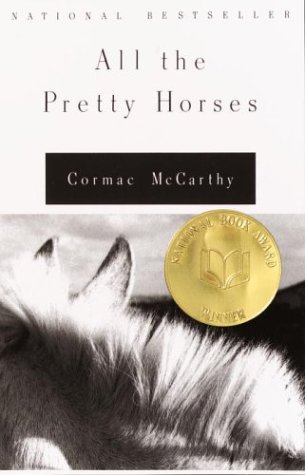
I recently finished the first volume of Cormac McCarthy's Border Trilogy called All The Pretty Horses. It was a very enjoyable read and it further solidified my appreciation for the author. This quote is indicative of a recurring theme throughout the book: Though things may appear to be random and chaotic, there is purpose and order in the universe.
You think God looks out for people? said Rawlins.
Yeah. I guess He does. You?
Yeah. I do. Way the world is. Somebody can wake up and sneeze somewhere in Arkansas or some damn place and before you’re done there’s wars and ruination and all hell. You dont know what’s goin to happen. I’d say He’s just about got to. I dont believe we’d make it a day otherwise.
John Grady nodded.
McCarthy's characters, for the most part, seem to understand that there is purpose in life, and particularly in suffering and trials. The characters seem, as opposed to many modern sentiments, grateful for their time on earth. Though there is no indication that these characters are Christian per se, they exhibit hope in light of difficulties and faith in light of despair.
One facet of my faith journey over the past 5-6 years has been the developing of a biblical theology of God's sovereignty. The beliefs I used to have regarding God and his reign were inherited, but not investigated. When I studied the Scripture and writings of respected theologians, my stance changed dramatically.
I now find God's meticulous sovereignty over the universe a source of assurance and faith. He is in control. Whether it be superstorms or silly circumstances, He is sovereign. And that is good, because "I dont believe we’d make it a day otherwise."
Wednesday, July 4, 2012
God creates evil. God is good. No problem?
Isaiah 45:7 is an extremely interesting and potentially explosive verse. It reads,
I form the light, and create darkness:
I make peace, and create evil:
I the Lord do all these things.
(Isaiah 45:7 KJV)
(Isaiah 45:7 KJV)
In God's Glory in Salvation through Judgment, author Jim Hamilton comments on this verse:
Isaiah 45:7 teaches that God is absolutely sovereign over all that is. This should not trouble us with questions about God's goodness. We know that he is good. He showed his goodness to Moses when he revealed himself as a saving and judging God (Ex. 33:18-34:7). Rather than being troubling, the teaching of Isaiah 45:7, that Yahweh created evil-that is what the text says-is a comfort, because it tells us, as hymned in "God Moves in a Mysterious Way," that behind the frowning providence of God hides a smiling face. God has good purposes that are not thwarted but accomplished by evil. Apart from this, hope could be challenged. But if God is even sovereign over evil, hope can be affirmed with full-throated, unabashed resolution. God will be glorified by all that is, even if we do not yet understand how everything will come together. (204, emphasis mine)
Though this passage provides numerous interesting ideas to investigate, I want to focus on the material that I emphasized. Dr. Hamilton suggests that this idea about God creating evil should not cause us to question God's goodness. For some, that statement might cause some consternation and leave them feeling as if the good doctor is not being entirely upfront. However, consider what Hamilton does not say.
He does not say that this is not something that requires some serious contemplation. He does not say that there is no mystery here. He does not say that this is really easy to understand.
What he says is this portion of Scripture should not cause us to question God's goodness because we know that he is good. And I concur.
Think of the great mercy extended to us at Christ's expense. Consider God's love in not rejecting humanity outright, but rather his offering redemption and reconciliation to his enemies. Deliberate his patience with us as we worship at the idols of this world. Reflect on all he suffered as our substitute. Speculate on the great joy he has for us, even now, in him.
Is there any room for questioning God's goodness? We must think over difficult doctrines and reconcile them with what we know to be true; God is good.
Tuesday, May 8, 2012
Tough teaching on sovereign grace
Therefore, while we all labour naturally under the same disease, those only recover health to whom the Lord is pleased to put forth his healing hand. The others whom, in just judgement, he passes over, pine and rot away till they are consumed. And this is the only reason why some persevere to the end, and others, after beginning their course, fall away. Perseverance is the gift of God, which he does not lavish promiscuously on all, but imparts to whom he pleases. If it is asked how the difference arises - why some steadily persevere, and others prove deficient in steadfastness, we can give no other reason than that the Lord, by his mighty power, strengthens and sustains the former, so that they perish not, while he does not furnish the same assistance to the latter, but leaves them to be monuments of instability. (Institutes 2.5.3)
These are some tough words by Calvin. I still cringe when I read words in the same vein as this teaching. Two things help me when I contemplate God's sovereignty in our salvation.
The first is that I only have one answer to the question "Do you believe that God is meticulously sovereign over all?" and that answer is a resounding YES. So be it.
Secondly, I remind myself that God's sovereignty does not negate human responsibility; all who reject God's love in Christ do so willingly and culpably.
That leaves me with a sense of the amazing mercy and grace of God in my life.
Wednesday, March 7, 2012
Jim Hamilton on sovereignty, sealing and suffering
After this I saw four angels standing at the four corners of the earth, holding back the four winds of the earth, that no wind might blow on earth or sea or against any tree. Then I saw another angel ascending from the rising of the sun, with the seal of the living God, and he called with a loud voice to the four angels who had been given power to harm earth and sea, saying, "Do not harm the earth or the sea or the trees, until we have sealed the servants of our God on their foreheads." And I heard the number of the sealed, 144,000, sealed from every tribe of the sons of Israel:
12,000 from the tribe of Judah were sealed,
12,000 from the tribe of Reuben,
12,000 from the tribe of Gad,
12,000 from the tribe of Asher,
12,000 from the tribe of Naphtali,
12,000 from the tribe of Manasseh,
12,000 from the tribe of Simeon,
12,000 from the tribe of Levi,
12,000 from the tribe of Issachar,
12,000 from the tribe of Zebulun,
12,000 from the tribe of Joseph,
12,000 from the tribe of Benjamin were sealed.
(Revelation 7:1-8 ESV)
Pastor and theologian Jim Hamilton discusses the above text in his recently published book Revelation: The Spirit Speaks to the Churches (Hamilton Jr., James M. Revelation: The Spirit Speaks to the Churches. Wheaton, IL: Crossway, 2012. Print). For Hamilton, the sealing of the saints speaks to God's sovereign control throughout the universe, particularly in regards to the suffering of the saints. He writes,
There are important lessons for us here: God is sovereign over the harmful forces in the world. The divine passive is a way to state that God has ultimate control over something while at the same time distancing God from it. This teaches us that the harmful things that happen do not surprise God. Satan has not tricked God. The world is not spinning out of God's control. God is in absolute control of everything that happens. Some things happen because he has given ability to an agent he has appointed to accomplish his purpose. God's purpose will be accomplished, even if humans and demons act wickedly (see 17:17).
In addition to the fact that God is sovereign over everything, even harmful things, we see in this passage that God actively protects his people. God keeps his own. Not one of them will be lost. The sealing in view here probably does not guarantee that the servants of God who are sealed will have no pain, but 9:4 indicates that those who are sealed are spared the pains of judgment. The sealing in view ensures the preservation of the servants of God in the faith. God seals them in the sense that he keeps convincing them that he is trustworthy. He keeps compelling them to trust him. He makes sure they will always have compelling evidence to believe what he has said.
There is comfort here for us, isn't there? You can be confident that no matter how bad it gets, you will not suffer the smallest bit more than God allows you to suffer. God will not allow the suffering to go farther than you can bear. You can also be confident that if God is in control, the suffering is not meaningless. In addition, you can be confident that God will never let you go (189).
Wednesday, February 8, 2012
Uncertain future events

As all future events are uncertain to us, so we hold them in suspense, as if they might incline to one side or the other. Yet in our hearts it nonetheless remains fixed that nothing will take place that the Lord has not previously foreseen. (Institutes 1.16.9)
Thursday, December 8, 2011
Why doesn't God heal?
If I believe Romans 8:28, that God sovereignly orchestrates all events in my life for my ultimate spiritual good (and preeminently for his ultimate glory), I can only conclude that, all things being equal, if I'm not healed it is because God values something in me greater than my physical comfort and health that he, in his infinite wisdom and kindness, knows can only be attained by means of my physical affliction and the lessons of submission, dependency, and trust in God that I learn from it. (Storms, C. Samuel. A Sincere and Pure Devotion to Christ: 100 Daily Meditations on 2 Corinthians. Vol. 2. Wheaton, IL: Crossway, 2010. Print. 236)
Tuesday, November 29, 2011
A proper perspective on providence
In this passage from Institutes of the Christian Religion, Calvin gives us an explanation why we need not be fatalistic despite believing that God has ordained all things that come to pass.
So, in light of God's meticulous providence of all things, what should our posture be in regards to the future? Calvin continues,
Read it again if you didn't follow the first time; this is hugely important if we want to avoid a fatalistic approach to life!
Yet the sluggishness of our minds lies far beneath the height of God's providence, we must employ a distinction to lift it up. Therefore, I shall put it this way: however all things may be ordained by God's plan, according to a sure dispensation, for us they are fortuitous. Not that we think that fortune rules the world and men, tumbling all things at random up and down, for it is fitting this folly be absent from the Christian's breast! But since order, reason, end, and necessity of those things which happen for the most part lie hidden in God's purpose, are not apprehended by human opinion, those things, which it is certain take place by God's will, are in a sense fortuitous. For they bear on the face of them no other appearance, according to our knowledge and judgment. (1.16.9)
So, in light of God's meticulous providence of all things, what should our posture be in regards to the future? Calvin continues,
As all future events are uncertain to us, so we hold them in suspense, as if they might incline to one side or the other. Yet in our hearts it nonetheless remains fixed that nothing will take place that the Lord has not previously foreseen. (1.16.9)
Read it again if you didn't follow the first time; this is hugely important if we want to avoid a fatalistic approach to life!
Wednesday, November 16, 2011
Benefits of attributing omnipotence to God
Those who attribute due praise to the omnipotence of God thereby derive a double benefit. He to whom heaven and earth belong, and whose nod all creatures must obey, is fully able to reward the homage which they pay to him, and they can rest secure in the protection of Him to whose control everything that could do them harm is subject, by whose authority, Satan, with all his furies and engines, is curbed as with a bridle, and on whose will everything adverse to our safety depends. In this way, and in no other, can the immoderate and superstitious fears, excited by the dangers to which we are exposed, be calmed or subdued. I say superstitious fears. For such they are, as often as the dangers threatened by any created objects inspire us with such terror, that we tremble as if they had in themselves a power to hurt us, or could hurt at random or by chance; or as if we had not in God a sufficient protection against them.
In this excerpt for The Institutes of the Christian Religion, Calvin puts forward two benefits to those who praise God for and exult in His omnipotence. He indicates that the recognition and resulting regard for the righteous power that resplendently resides in the Ruler of the universe results in two advantages. First, a supremely powerful God has the wherewithal to do good to those who subject themselves to Him. And secondly, superlative safety is within the purview of One to whom all harmful things, of this world or otherwise, are subservient to. God's omnipotence supports His sovereignty. He can back himself up!
Wednesday, November 9, 2011
God uses the sun, but needs it not

No creature has a force more wondrous or glorious than that of the sun. For besides lighting the whole earth with its brightness, how great a thing is it that by its heat it nourishes and quickens all living things! That with its rays it breathes fruitfulness into the earth! That it warms the seeds in the bosom of the earth, draws them forth with budding greenness, increases and strengthens them, nourishes them anew, until they rise up into stalks! That it feeds the plant with continual warmth, until it grows into a flower, and from flower into fruit! That then, also, with baking heat it brings the fruit to maturity! Yet the Lord, to claim the full credit for all these things, willed that, before he created the sun, light should come to be and earth be filled with all manner of herbs and fruits [Gen. 1:3, 11, 14]. Therefore a godly man will not make the sun a principal or necessary cause of these things which existed before the creation of the sun, but merely the instrument that God uses because he so wills; for with no more difficulty he might abandon it, and act through himself. John Calvin, Institutes 1.16.2
Saturday, December 4, 2010
No great matter

“To be sovereign of the universe is no great matter to God.”
C. S. Lewis, The Four Loves (New York, 1960), pages 175-176.
HT: Ray Ortlund
Tuesday, June 22, 2010
Two great quotes from The Puritan's Woodshop
From The Puritan's Woodshop:
In one of his letters on the importance of Systematic Divinity, Andrew Fuller deals with the seeming inconsistency between Divine predestination and human responsibility. He points out the difference between the reasoning of the fleshly mind versus the Christian.
Charles H. Spurgeon understood that just because our minds cannot get a grip on the harmony of truth it does not mean that they are simply contradictory. He sees God predestinating and the responsibility of man as harmonious. He writes in his autobiography:
In one of his letters on the importance of Systematic Divinity, Andrew Fuller deals with the seeming inconsistency between Divine predestination and human responsibility. He points out the difference between the reasoning of the fleshly mind versus the Christian.
A fleshly mind may ask, “How can these things be?” How can Divine predestination accord with human agency and accountableness? But a truly humble Christian, finding both in his Bible, will believe both, though he may be unable fully to understand their consistency; and he will find in the one a motive to depend entirely on God, and in the other a caution against slothfulness and presumptuous neglect of duty. And thus a Christian minister, if he view the doctrine in its proper connexions, will find nothing in it to hinder the free use of warnings, invitations, and persuasions, either to the converted or the unconverted. Yet he will not ground his hopes of success on the pliability of the human mind, but on the promised grace of God, who (while he prophesies to the dry bones, as he is commanded) is known to inspire them with the breath of life. - Andrew Fuller
Charles H. Spurgeon understood that just because our minds cannot get a grip on the harmony of truth it does not mean that they are simply contradictory. He sees God predestinating and the responsibility of man as harmonious. He writes in his autobiography:
“That God predestines, and yet that man is responsible, are two facts that few can see clearly. They are believed to be inconsistent and contradictory, but they are not. The fault is in our weak judgment. Two truths cannot be contradictory to each other. If, then, I find taught in one part of the Bible that everything is fore-ordained, that is true; and I find that in another Scripture, that man is responsible for all his actions, that is true; and it is only my folly that leads me to imagine that these two truths can ever contradict each other. I do not believe they can ever be welded into one upon any earthly anvil, but they certainly shall be one in eternity. They are two lines that so nearly parallel, that the human mind which pursues them farthest will never discover that they converge, but they do converge, and they will meet somewhere in eternity, close to the throne of God, whence all truth doth spring.” (C.H. Spurgeon Autobiography: Volume 1: The Early Years; Banner of Truth; page 174)
Monday, June 14, 2010
God's Sovereignty Over Evil
Here are some quotes from a sermon I preached this morning:
And what I mean in this message when I say that God is sovereign is not merely that God has the power and right to govern all things, but that he does govern all things, for his own wise and holy purposes. John Piper
The sovereignty of God I take to be the absolute authority, rule, and government of God in the whole of that reality that exists distinct from Himself in the realms of nature and of grace. It is a concept that respects His relation to other beings and to all other being and existence. John Murray
To say that God's controlling power is efficacious is simply to say that it always accomplishes its purpose. God never fails to accomplish what he sets out to do. John Frame
4.God's exercise of power over His creation ... His exercise of rule over creation ... God has a purpose in all that He does in the world and He providentially governs or directs all things in order that they accomplish his purposes. Wayne Grudem
5.We believe that God upholds and governs all things—from galaxies to subatomic particles, from the forces of nature to the movements of nations, and from the public plans of politicians to the secret acts of solitary persons—all in accord with His eternal, all-wise purposes to glorify Himself, yet in such a way that He never sins, nor ever condemns a person unjustly; but that His ordaining and governing all things is compatible with the moral accountability of all persons created in His image. Desiring God - Rebuilding Some Basics of Bethlehem: 10 Reasons Why Believing in the Sovereignty of God Matters
We must remember that we are all born sinful. Because of Adam's sin, we all come into the world with sinful hearts. Thus, God doesn't cause sin by taking righteous people and making them do what they don't want to. He does not inject sinful desires into people. Rather, we are already sinful. God simply leaves us to our own natures and makes use of the evil that is already there. Thus, we are responsible for our sinful actions because they proceed from our own heart. The source of sin is in the human heart, not God. What God does is divide, arrange, and direct the sin in the human heart, so that it manifests itself according to His purposes ...
The sin in the human heart is not produced by God. Rather, He is the negative cause of it because He is permitting it to exist when He could change it. Further, it seems that God uses negative causation and secondary causation to specifically direct the course of human sin. But God does this in such a way that He is never the positive cause of sin--that is, he is never the producer of evil in a person's heart ... John Frame
And what I mean in this message when I say that God is sovereign is not merely that God has the power and right to govern all things, but that he does govern all things, for his own wise and holy purposes. John Piper
The sovereignty of God I take to be the absolute authority, rule, and government of God in the whole of that reality that exists distinct from Himself in the realms of nature and of grace. It is a concept that respects His relation to other beings and to all other being and existence. John Murray
To say that God's controlling power is efficacious is simply to say that it always accomplishes its purpose. God never fails to accomplish what he sets out to do. John Frame
4.God's exercise of power over His creation ... His exercise of rule over creation ... God has a purpose in all that He does in the world and He providentially governs or directs all things in order that they accomplish his purposes. Wayne Grudem
5.We believe that God upholds and governs all things—from galaxies to subatomic particles, from the forces of nature to the movements of nations, and from the public plans of politicians to the secret acts of solitary persons—all in accord with His eternal, all-wise purposes to glorify Himself, yet in such a way that He never sins, nor ever condemns a person unjustly; but that His ordaining and governing all things is compatible with the moral accountability of all persons created in His image. Desiring God - Rebuilding Some Basics of Bethlehem: 10 Reasons Why Believing in the Sovereignty of God Matters
We must remember that we are all born sinful. Because of Adam's sin, we all come into the world with sinful hearts. Thus, God doesn't cause sin by taking righteous people and making them do what they don't want to. He does not inject sinful desires into people. Rather, we are already sinful. God simply leaves us to our own natures and makes use of the evil that is already there. Thus, we are responsible for our sinful actions because they proceed from our own heart. The source of sin is in the human heart, not God. What God does is divide, arrange, and direct the sin in the human heart, so that it manifests itself according to His purposes ...
The sin in the human heart is not produced by God. Rather, He is the negative cause of it because He is permitting it to exist when He could change it. Further, it seems that God uses negative causation and secondary causation to specifically direct the course of human sin. But God does this in such a way that He is never the positive cause of sin--that is, he is never the producer of evil in a person's heart ... John Frame
Sunday, June 13, 2010
God's Sovereignty
Speaking of how one articulates the truths associated with God's sovereignty in general, and His sovereignty over evil in particular, John Frame wrote this in His excellent work The Doctrine of God: "Our language must not compromise either God's full sovereignty or His holiness and goodness."
With that in mind, I will once again post on this blog the best example that I have come across of someone articulating this truth in a manner that meets the criteria that Frame introduces above.
"To put it bluntly, God stands behind evil in such a way that not even evil takes place outside the bounds of his sovereignty, yet the evil is not morally chargeable to him: it is always chargeable to the secondary agents, to secondary causes [i.e., those who actually do it]. On the other hand, God stands behind good in such a way that it not only takes place within the bounds of his sovereignty, but it is always chargeable to him, and only derivatively to secondary agents...If this sound just a bit too convenient for God, my initial response (though there is more to be said) is that according to the Bible this is the only God there is."
With that in mind, I will once again post on this blog the best example that I have come across of someone articulating this truth in a manner that meets the criteria that Frame introduces above.
"To put it bluntly, God stands behind evil in such a way that not even evil takes place outside the bounds of his sovereignty, yet the evil is not morally chargeable to him: it is always chargeable to the secondary agents, to secondary causes [i.e., those who actually do it]. On the other hand, God stands behind good in such a way that it not only takes place within the bounds of his sovereignty, but it is always chargeable to him, and only derivatively to secondary agents...If this sound just a bit too convenient for God, my initial response (though there is more to be said) is that according to the Bible this is the only God there is."
Monday, May 31, 2010
Tuesday, December 15, 2009
Chapter 6- The Sovereignty of God

I skipped writing on chapter 5 which was entitled the Supremacy of God because this chapter is "described as the exercise of his supremacy." Here's a few quotes.
"Divine sovereignty means that God is God in fact, as well as in name, that he is on the Throne of the universe, directing all things, working all things "after the counsel of his own will" (Eph. 1:11)."
"There is no attribute more comforting to His children than that of God's Sovereignty. Under the most adverse circumstances, in the most severe trials, they believe that Sovereignty has ordained their afflictions, that Sovereignty overrules them, and that Sovereignty will sanctify them all. There is nothing for which the children ought more earnestly contend than the doctrine of their Master over all creation- the Kingship of God over all the works of His own hands- the Throne of God and His right to sit upon that Throne."-C.H. Spurgeon
"He will is supreme. So far from God being under any law of "right", he is unto himself, so that whatsoever he does is right. And woe be to the rebel that calls his sovereignty into question: "Woe unto him that striveth with his Maker. Let the potsherd strive with the potsherds of the earth. Shall the clay say to him that fashioned it, What makest Thou?" (Isa. 45:9)."
"Many have most foolishy said that it is quite impossible to show where Divine sovereignty ends and creature accountability begins. Here is where creature responsibility begins: in the sovereign ordination of the Creator. As to his sovereignty, there is not and never be any "end" to it!"
"Here, then, is the highest and grandest display of the absolute sovereignty of God. Verily, he has "mercy on whom he will have mercy, and whom he will he hardeneth" (Rom. (:18)."
Thursday, November 5, 2009
Reconcilable "apparent contradictions"
The doctrines that are most often described as "apparently contradictory" are divine sovereignty and human freedom, the problem of evil, and the Trinity. Cornelius Van Til believed that these doctrines involve "apparent contradictions" that can never be reconciled by the human mind. However, I don't think Scripture tells us which apparent contradictions are reconcilable by men and which are not...Some apparent contradictions can be removed by careful study of God's Word. Others, perhaps, await future increases in our Bible knowledge, or even, perhaps, future developments in the science of logic itself. Others, perhaps, await the vastly increased knowledge of God (1 Cor. 13:1-12; 1 John 3:2) that we will gain when we meet him in glory. And some may be such that creaturely minds can never reconcile them.
If there are some apparent contradictions that we cannot reconcile (now, or in the future, or ever), we should try and hold both sides of the paradox, as best we can, and walk by faith. If divine sovereignty and human responsibility seem contradictory to us, we may and should, nevertheless, both continue to regard God as sovereign and acept responsibility for our thoughts and actions. And in this case, we should be careful not to adopt any apparently logical inferences from divine sovereignty that compromise human responsibility, or vice versa.
Our faith does not depend on our being able to reconcile all apparent contradictions. Rather, it rests on the solid foundation of God's revelation of himself-in creation, in Scripture, and in Christ. So we will walk by faith, rather than by sight. (Frame, John. The Doctrine of God. New Jersey: P & R Publishing. 2002. 512)
Tuesday, October 27, 2009
The Strategies of Satan

From Enjoying God Ministries, Storms writes about the methods that Satan uses to undermine all of creation. In one of his points, Storms expresses how even through Satan's attempts at causing us to sin, God remains sovereign. Using the example of Peter denying Christ three times, we see that Satan had a specific agenda, but God being sovereign, had an agenda that superseded that of Satan's, and taught Peter some valuable lessons.
"He tests or tries Christians, the malicious “sifting” “like wheat” of Peter’s faith being an excellent example (Luke 22:31). Clearly, Satan is unable to act outside the parameters established by the will of God but must first ask permission. He wanted to destroy Peter by inciting him to deny Jesus. But God's intent in permitting Satan to do it was altogether different. God's purposes with Peter were to instruct him, humble him, perhaps discipline him, and certainly to use him as an example to others of both human arrogance and the possibility of forgiveness and restoration. This points to the fact that often we cannot easily say "Satan did it" or "God did it". In cases such as this, both are true (with the understanding that God's will is sovereign, supreme, and overriding), but their respective goals are clearly opposite. Sydney Page's comments concerning this incident are important:
"Luke 22:31-32 reveals that Satan can subject the loyalty of the followers of Jesus to severe tests that are designed to produce failure. So intense are the pressures to which Satan is able to subject believers that the faith of even the most courageous may be found wanting. Satan is, however, limited in what he can do by what God permits and by the intercession of Jesus on behalf of his own [cf. Rom. 8:34; Heb. 7:25; 1 John 2:1]. Furthermore, those who temporarily falter can be restored and, like Peter, can even resume positions of leadership. It is implied that Satan cannot gain ultimate victory over those for whom Jesus intercedes" (124). "
"Luke 22:31-32 reveals that Satan can subject the loyalty of the followers of Jesus to severe tests that are designed to produce failure. So intense are the pressures to which Satan is able to subject believers that the faith of even the most courageous may be found wanting. Satan is, however, limited in what he can do by what God permits and by the intercession of Jesus on behalf of his own [cf. Rom. 8:34; Heb. 7:25; 1 John 2:1]. Furthermore, those who temporarily falter can be restored and, like Peter, can even resume positions of leadership. It is implied that Satan cannot gain ultimate victory over those for whom Jesus intercedes" (124). "
Subscribe to:
Posts (Atom)