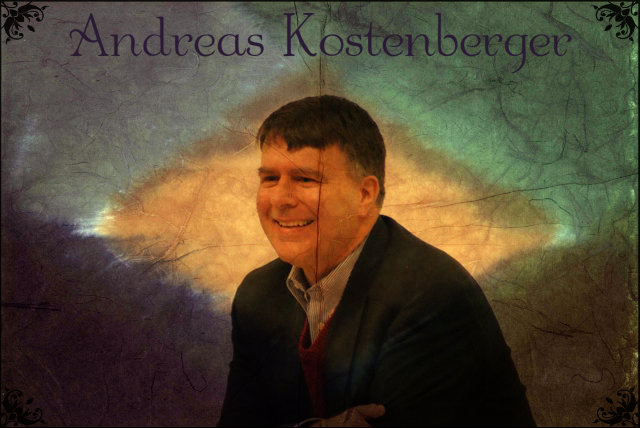
Thursday, March 28, 2013

How did Jesus live his life?

I have already gone on record as being positively affected by Bruce Ware's recently published book on the humanity of Christ called The Man Christ Jesus ( see here and here). I continue to be encouraged by this book as I reflect on the message it sends regarding the God-man Jesus Christ. One of the main contention of the book is evidenced in a question, and its answer, that Ware presents early on in the book:
What dimensions of the life, ministry, mission, and work of Jesus Christ can be accounted for and fully understood rightly only when seen through the lens of his humanity? Put differently, while Christ was (and is)
 fully God and fully man, how do we best account for the way in which he lived his life and fulfilled his calling-by seeing him carrying out this as God, or as man, or as the God-man? I would respond that the most responsible answer biblically and theologically is the last, as the God-man, but that the emphasis must be placed on the humanity of Christ as the primary reality he expressed in his day-by-day life, ministry, and work (32).
Ware continues to answer this question with the following: "But while he was fully God, and while this is crucial to understanding rightly his full identity, his life, and the fulfillment of his atoning work, the predominant reality he experienced day by day, and the predominant means by which he fulfilled his calling, was that of his genuine and full humanity" (33).

This is an approach that Ware takes that is foundational to understanding the book and undergirds almost everything he argues for. Remember, Ware is a staunch proponent of orthodox trinitarian doctrine as has written on the subject. What he makes note of in this book is that to understand Christ, and some of the mystery surrounding his life as he lived it, is found in perceiving Jesus with lenses that emphasize his humanity as the predominant reality through which he lived on this planet.

Wednesday, March 27, 2013

The Wonder

"In eternity past Christ saw all our faults, and not one after another, but altogether. This adds great wonder to the love of Christ. He saw every perverse look, every unkind gesture, every rebellious motion, every disingenuous act. Every heart was visible from eternity. Here is the wonder of Christ's love: it is fixed upon man, the worst of creatures. Consider his resolution, and wonder: I will give eternal life to those who have dishonoured me."
David Clarkson

Monday, March 25, 2013

God as depicted by Scripture

From Institutes of the Christian Religion 4.12.1:
How shall we reply to the Heavenly Judge when he calls us to account? Let us envisage for ourselves that Judge, not as our minds naturally imagine him, but as he is depicted for us in Scripture:
  • by whose brightness the stars are darkened (Job 3:9);
  • by whose strength the mountains are melted;
  • by whose wrath the earth is shaken (cf. Job 9:5-6);
  • whose wisdom catches the wise in their craftiness (Job 5:13);
  • beside whose purity all things are defiled(Job 25:5);
  • whose righteousness not even the angels can bear (cf. Job 4:18);
  • who makes not the guilty man innocent (cf. Job 9:20);
  • whose vengeance when once kindled penetrates to the depths of hell (Deut. 32:22; cf. Job 26:6).

Thursday, March 21, 2013

Dodson on mortification

In blogging through Jonathan K. Dodson's book on discipleship entitled Gospel Centered Discipleship, I have arrived at the section of the book which concerns itself with practical application of what it expounded and explained in earlier chapters. As the book discusses applying the Gospel, it engages with mortification in the Christian life. I love how Dodson defines mortification writing, "Mortification is that tenacious disposition of the heart that longs to defeat sin out of love for Jesus" (128, emphasis mine).

The motivation for mortification which the author notes in this definition is incredibly important. Over the ages many people have tried, both Christian and non-Chritian, to conform their actions and change their habits from a desire to meet some perceived standard, to "be all that you can be." But ultimately, being moral for morality's sake, or good for goodness' sake, gets you no further ahead than were you to remain as you were.

God is not looking for us to conform to some set of rules whether they be encoded or arbitrary. He is looking for us to be conformed to his Son. And thus, our motivation for conformity and mortification of those areas in our life which are not conformed, needs to be found in Christ.

Dodson continues with an encouraging passage on fighting sin in our life:
Sin is no lighthearted matter. It is crouching at our door and we must master it (Gen. 4:7). It is dangerous not to fight sin.It is a sobering fight we must not cease. Fight your sin means a habitual weakening of the flesh through constant fighting and contending in the Spirit for sweet victory over sin. It should be regular and progressive, not occasional and instant. Fighting is not an end in itself or a way to make us more presentable to God. We fight because we have been made presentable in Christ. We fight for belief in his gospel, the truest and best news on earth-that Jesus defeated our sin, death, and evil through his own death and resurrection, and he is making all things new, even us. Until all things are new, we will continue to fight the good fight of faith. (128-9)
Keep fighting!

Wednesday, March 20, 2013

The soul-shrinking effect of sin

In Lecture VIII of Charity and Its Fruits, Jonathan Edwards scrutinizes selfishness and contrasts it in light of charity. As Edwards notes, "The ruin that the fall brought upon the soul of man consists very much in his losing the nobler and more benevolent principles of his nature, and falling wholly under the power and government of self-love." Selfishness became an inseparable part of the human condition at the fall.

This selfishness was opposed to the way in which he was created by God; "exalted, and noble, and generous." Rather, " the mind of man shrank from its primitive greatness and expandedness, to an exceeding smallness and contractedness." This idea, the soul-shrinking effect of sin, is particularly seen in acts of selfishness.

Despite being endowed at creation with a rich, vibrant, and loving soul that was after God's own image,
soon afterward
these noble principles were immediately lost, and all this excellent enlargedness of man's soul was gone; and thenceforward he himself shrank, as it were, into a little space, circumscribed and closely shut up within itself to the exclusion of all things else. Sin, like some powerful astringent, contracted his soul to the very small dimensions of selfishness.
Edwards gives us a description of the size and shape and volume of selfishness: small. That is one of the effects sin has on us. It is a contracting, constraining, constricting cancer that minimizes, and, if left uncured, leads us to death.

Edwards continues looking at the outcomes of man's love affair with himself.
God was forsaken, and fellow creatures forsaken, and man retired within himself, and became totally governed by narrow and selfish principles and feelings. Self-love became absolute master of his soul, and the more noble and spiritual principles of his being took wings and flew away.
Fortunately, that was not the end of the story. Edwards began at the beginning of the metanarrative of the Bible with Creation. He relates the second part of the over-arching story of mankind, the fall of man. But Edwards continues with Scripture's story arc, not leaving us mired in sin, rather encouraging us with the next part of God's unfolding plan, redemption.

Edwards writes,
But God, in mercy to miserable man, entered on the work of redemption, and, by the glorious gospel of his Son, began the work of bringing the soul of man out of its confinement and contractedness, and back again to those noble and divine principles by which it was animated and governed at first. And it is through the cross of Christ that he is doing this; for our union with Christ gives us participation in his nature.
And so, the remedy for our shrinking soul is union with our saving Sovereign through his Son. Edwards explains this majestic and merciful movement of God as an enlargement, an extensiveness, and a filling out of the Christian.
And so Christianity restores an excellent enlargement, and extensiveness, and liberality to the soul, and again possesses it with that divine love or charity that we read of in the text, whereby it again embraces its fellow creatures, and is devoted to and swallowed up in the Creator. And thus charity, which is the sum of the Christian spirit, so partakes of the glorious fullness of the divine nature, that she "seeketh not her own," or is contrary to selfish spirit.
I'm sure Edwards would agree that the final eradication of the soul-shrinking effects of sin will come in the final phase of the world's history-the consummation-where we will meet Christ and he will reconcile all things. Then, and only then, will humanity reach the full stature of Christ. This largess of largness is the final chapter of the story of man and the story of God.

Tuesday, March 19, 2013

Our knowledge has limitations


Vern S. Poythress  in his book on Gospel harmonization called Inerrancy and the Gospels:
Even when we study the Gospels carefully, prayerfully, and attentively, we do not understand everything ...

We know that God knows all the solutions. Yet we cannot demand a clear solution to all of our difficulties right now. We do not have massive informative detail about each episode recorded in the Gospels. we have only what the Gospels themselves choose to tell us ...

God knows all the details about what happened. It all makes sense in his mind. But we have our piecemeal knowledge. We cannot insist before God that he must always give us enough information in order to "solve" or disprove all the difficulties that we perceive. He is God. He does as he pleases (Ps. 115:3). He acts according to the infinitude of his wisdom, a wisdom that he has revealed in a wonderful and spectacular way in the mystery of the crucifixion and resurrection of Christ. He is wise, but we cannot always see that when we want to have more information than the Gospels provide. We must patiently submit to his wisdom in such cases (91).

Thursday, March 14, 2013

Book Review - Shakespeare's Macbeth


I dare do all that may become a man; Who dares do more, is none” is Macbeth’s response to his wife when she challenges him to kill his sovereign. Macbeth’s response, among other things, suggests that when people try to overreach their position, it leads to failure; to be a man one must fulfill one’s role and obligations and nothing more. To do more is to fail.

The same could be said of books. Books that attempt to accomplish more than the purpose of their writing often end neither succeeding to attain the ‘vaulted ambition’ (read the play for clarity) nor the original intended end. Books, and men, should know their role.

Shakespeare’s Macbeth, by Leland Ryken, is a book that cannot be accused of overstepping its purpose. Crossway’s Christian Guides to the Classics series aims to help the intimidated or unfamiliar reader in their pursuit of reading classic literature. This guide accomplishes that.

Interestingly, in fulfilling its intended mandate, this small but potent work attains more; I think it is helpful for those beyond the scope of its appointed audience. As a secondary school English teacher who teaches Macbeth several times a year, I found this guide helpful and thus suggest that teachers will similarly find this guide useful.

Readers who are interested in reading this classic Shakespearean tragedy, whether they find this genre daunting or they feel they need some extra help, will find that this guide will assuage their fears and bolster their confidence. In particular, I think this educational tool would benefit students significantly. And the more experienced reader, perhaps familiar with the play or even responsible to teach it to others, will also find this book valuable.

Aside from the compelling and intriguing insights of its acclaimed writer, this guide is largely successful due to its format.

The book includes an introduction to Shakespeare, the play itself, and the context in which it was written. These features, along with the Plot Summary section for each scene, are suited to help those who approach the Bard’s work with imperceptible trepidation or unabashed trembling. The uninitiated reader will find these helpful as well.

The Commentary section along with the For Reflection or Discussion section will aid those involved in the study of Macbeth including both teachers and student. In Ryken’s apt analysis and explanations I found interesting tidbits of knowledge that I will use as I teach the play, but that I also found these nuggets delightful in and of themselves. Ryken’s expositions of scenes and acts are concise without being meagre. This keeps the guide short and useful.

Finally, in the margin on almost every page are points of interest, many of which pertain and speak to the Christian worldview. As a Christian educator in a public school system, I found these excursions refreshing and edifying. Placing this massive literary accomplishment in the context of the Kingdom of God sets this work apart from most other introductory material on this play.

I recommend this book to those who inwardly cower at the thought of reading something from Shakespeare yet recognize that this incredible playwright cannot be ignored. I recommend this book for the willing reader who desires a steadying arm on the journey into this wonderful tragedy. I recommend this reader for both teachers and students who will encounter the ‘Scottish Play’ in their course of study.

Monday, March 11, 2013

An article on pain


The good people at Gospel Centered Discipleship have posted another article of mine at their site. Here is an excerpt from the article:


Using pain as a preparatory mechanism is quite common in football. Before a game, in the locker room or on the sidelines, you will often see teammates hitting each other or slapping each other on their shoulders. Many football players claim that they can’t really get into a game until they receive or deliver their first hit. There is something about the pain that brings purposefulness and clarity in combative sports.

It seems that pain in ‘real’ life, whether physical, emotional, or mental, does the exact opposite of what it does in football. For many people, pain leads to paralysis instead of performance. Pain doesn’t help us engage; it causes us to detach, disassociate, and disconnect from life. When the life gets tough, genuinely tough, the accepted response is to quit. We do not regain focus on the end and purpose of our lives. Instead, we abandon engagement in life.

Read the rest of the article here.

Friday, March 8, 2013

The Holy Spirit and decision making

The role of the Spirit in decision making can bring up some contentious issues. Extremes range from the charismaniac who is always looking for some type of "sign" from God to the hardcore cessationist who will deny any sort of input-prompting, impulse, intuition-that could be attributed to God's direction. This may be a difficult area for Christians to navigate, but I think this excerpt from Gospel Centered Discipleship is helpful in terms of adding some balance to the backlash against the Spirit's involvement in our decision making.
After his baptism, Jesus was "lead by the Spirit in the wilderness for forty days, being tempted by the devil" (Luke 4:1-2). Notice that the Spirit played a directive role in the life of the Son of God. Mark tells us that the Spirit "drove" Jesus into the wilderness (Mark 1:12). Jesus clearly relied on the Spirit for direction. This sensitivity to the directing influence of the Holy Spirit is characteristic of the disciples in the book of Acts. Philip is directed to speak to the Ethiopian eunuch (Acts 8). Peter is directed to the house of Cornelius (Acts 10). The Jerusalem Council is Spirit directing your life? Very often, our modern, self-reliant sensibilities cut the Spirit right out of everyday decision making. Rarely do we request or expect the Spirit's direction. Yet, we are repeatedly told to "walk" in the Spirit throughout the Bible (Ezek. 36:27; Rom. 8:4; Gal. 5:16,25) and to make decisions by seeking the Lord (Prov. 5:4-6; James 4:13-15). Being motivated by the Spirit should affect not just normal decisions but also our general approach to life. Paul tells us to be "filled with the Spirit" (Eph. 5:18). How often do we start our day by requesting a fresh infilling of the Spirit's power for the day that lies ahead? Instead, we assume his presence and barrel forward. Our assumption of the Spirit reveals a self-reliant faith. Instead of starting and continuing our days in our own strength, what would it look like to fight for faith with utter dependence upon the power and direction of the Holy Spirit? (92)

Thursday, March 7, 2013

Why Public Schools Should Teach the Bible

As a teacher in the public system, and an English teacher no less, I found this article in the Wall Street Journal very interesting:

Why Public Schools Should Teach the Bible

Have you ever sensed in your own life that "the handwriting was on the wall"? Or encouraged a loved one to walk "the straight and narrow"?

Have you ever laughed at something that came "out of the mouths of babes"? Or gone "the extra mile" for an opportunity that might vanish "in the twinkling of an eye"?

If you have, then you've been thinking of the Bible.

These phrases are just "a drop in the bucket" (another biblical phrase) of the many things we say and do every day that have their origins in the most read, most influential book of all time. The Bible has affected the world for centuries in innumerable ways, including art, literature, philosophy, government, philanthropy, education, social justice and humanitarianism. One would think that a text of such significance would be taught regularly in schools. Not so. That is because of the "stumbling block" (the Bible again) that is posed by the powers that be in America.

It's time to change that, for the sake of the nation's children. It's time to encourage, perhaps even mandate, the teaching of the Bible in public schools as a primary document of Western civilization.

Read the whole article here.

Wednesday, March 6, 2013

The wrong starting point

Now I know there are many who, looking at the state of the church today, feel that the one thing for us to do is immediately to consider what methods we can employ in order to win outsiders. That is a perfectly right and good thing to think about. But they start with that. They say, "Here we are, and there are people outside who are indifferent to the church," and immediately they begin to consider means and methods of interesting and attracting outsiders. And some of them seem to be prepared to go to almost any lengths and to borrow any measures conceivable from the world itself in order to do something to get hold of these people. Now while I am in total agreement with evangelism and would be among the first to say that the primary task of the Christian church is evangelism, I do, nevertheless, suggest that when we start immediately to think of the methods, of what we can do, to attract those who are outside, we are stating at the wrong point.

(Lloyd-Jones, David Martyn. Setting Our Affections upon Glory: Nine Sermons on the Gospel and the Church. Wheaton, IL: Crossway, 2013. Print. 68)

Tuesday, March 5, 2013

Splendid Sins

As I blog through J. C. Ryle's book Holiness I am re-astounded at the quality of his writing; every page seems full of valuable content. Choosing quotes and excerpts to blog feels like choosing Wayne Gretzky's best goals. How does one decide? Nevertheless, we'll carry on. This passage jumped out at me because of the reference to 'splendid sins'. It seems an adequate phrase to describe the best works of humanity. It reminded me John Piper spoke of sinning in the very act of repenting of sin. This might lead some to see futility in the Christian walk. However, do not lose sight of another phrase in this excerpt that reminds us that sinful though our action may be, 'yet it pleases God.' Consider,
Sanctification, again, is a thing which cannot justify a man, and yet it pleases God. This may seem wonderful, and yet it is true. The holiest actions of the holiest saint that ever lived are all more or less full of defects and imperfections. They are either wrong in their motive or defective in their performance, and in themselves are nothing better than “splendid sins,” deserving God’s wrath and condemnation. To suppose that such actions can stand the severity of God’s judgment, atone for sin, and merit heaven, is simply absurd. ... The only righteousness in which we can appear before God is the righteousness of another - even the perfect righteousness of our Substitute and Representative, Jesus Christ the Lord.

Monday, March 4, 2013

Edwards and self-affirmation

This flies in the face of modern concepts of self-affirmation which would recoil with ideas that consider ourselves anything less than the center of the universe:

Seek for a deep and abiding sense of your comparative meanness before God and man. 
Know God.
Confess your nothingness and ill-desert before him.
Distrust yourself.
Rely only on God.
Renounce all glory except from him.
Yield yourself heartily to his will and service.
Avoid an
aspiring,
ambitious,
ostentatious,
assuming,
arrogant,
scornful,
stubborn,
willful,
leveling,
self-justifying behavior; 
and strive for more and more of the humble spirit that Christ manifested while he was on earth.

Edwards does not just suggest that we should understand our "meanness" before God, but rather we should actively seek a sense of this lowness. This might very well be the tonic for the "world revolves around me" mentality that our culture imposes on all of us.

Friday, March 1, 2013

Autonomous thought

An excerpt from Inerrancy and the Gospels: A God Centered Approach to the Challenges of Harmonization by Vern Poythress:

... in the realm of thought, the basic issue separating Christians from non-Christians is the issue of autonomy of thought. Ever since the fall of Adam, non-Christians have wanted to be autonomous judges and thinkers and decision makers. They want ultimate control of their lives. And to the extent that we as Christians give way to sin, we do the same thing. To an autonomous thinker, the process of studying Scripture with a commitment to God and his word seems circular, because it involves what he thinks is a bad commitment, a commitment to treat as ultimate something outside of himself. To someone who worships autonomy, autonomy is the ultimate. Commitment to Scripture seems to be a betrayal of who he is. Before he makes any commitment, the autonomous thinker wants to be allowed autonomously to judge the wisdom of such commitment (85).

Thursday, February 28, 2013

Two natures as mystery

From Bruce A. Ware in his book The Man Christ Jesus:

Surely the outworking of the two natures of Jesus is beyond our full comprehension. Just as with the doctrine of the Trinity in which we have in human life or experience no exact correspondence to God, who is one in essence and three in persons, so too here. We are incapable of understanding completely how one person could have two full and integral natures, especially when one of those natures is uncreated, infinite, and fully divine while the other nature is created, finite, and fully human. How was it that Christ lived fully as a man while being also fully God always has been and shall be, ultimately, a mystery (23).

Monday, February 25, 2013

Doctrine and the church

From Setting Our Affections Upon Glory by D. M. Lloyd-Jones:
Doctrine comes before fellowship, and unless our fellowship is based upon doctrine, it is not Christian fellowship ...

The church in her great periods has always seen the absolute necessity of defining what she believes in order that wrong teaching might be corrected and driven out. That is why teaching or doctrine must always come before fellowship. There is nothing more dangerous to the true life of the church than reversing this order and putting fellowship before doctrine (55-58)

Friday, February 22, 2013

Sanctification always follows regeneration

In his book Holiness, J. C. Ryle makes it clear that sanctification, or growth in holiness, is not an option for the Christian. Ryle argues that without sanctification evidencing the Christian life, there is no reason to conclude that regeneration ever took place. Consider:
Sanctification, again, is the outcome and inseparable consequence of regeneration. He that is born again and made a new creature, receives a new nature and a new principle, and always lives a new life. A regeneration which a man can have, and yet live carelessly in sin or worldliness, is a regeneration invented by uninspired theologians, but never mentioned in Scripture. On the contrary, St. John expressly says, that “He that is born of God doth not commit sin - doeth righteousness - loveth the brethren - keepeth himself - and overcometh the world.” (1 John ii. 29; iii. 9-14; v. 4-18.) In a word, where there is no sanctification there is no regeneration, and where there is no holy life there is no new birth. This is, no doubt, a hard saying to many minds; but, hard or not, it is simple Bible truth. It is written plainly, that he who is born of God is one whose “seed remaineth in him, and he cannot sin, because he is born of God.” (1 John iii. 9.)

Thursday, February 21, 2013

Edwards defines the Gospel

In Charity and Its Fruits, Jonathan Edwards defines the Gospel:
The gospel, above all things in the world, holds forth the exceeding condescension of God. No other manifestation that ever God made of himself exhibits such wonderful condescension as the Christian revelation does. The gospel teaches how God, who humbles himself to behold things that are in heaven and earth, stooped so low as to take an infinitely gracious notice of poor vile worms of the dust, and to concern himself for their salvation, and so as to send his only-begotten Son to die for them, that they might be forgiven, and elevated, and honoured, and brought into eternal fellowship with him, and to the perfect enjoyment of himself in heaven for ever.

Wednesday, February 20, 2013

Kostenberger on Progressive Spirituality


From Excellence: The Character of God and the Pursuit of Scholarly Virtue by A. Kostenberger:

Along with this definitive, positional spirituality, the New Testament also enjoins all followers of Christ to pursue progressive spirituality. John, as mentioned, exhorts believers to abide in Christ
(John 15:4-7). Paul commands believers to be filled with the Spirit (Eph. 5:18); to walk, or keep in step with, the Spirit(Gal. 5:16, 25); and not to grieve (Eph. 4:30) or quench the Spirit (1 Thess. 5:19). This implies that it is possible for believers, who are spiritual because they belong to Christ and are indwelt by the Spirit, not to walk in the Spirit and thus to grieve the Spirit and to quench the Spirit's activity in their lives. What can we learn about the pursuit of progressive spirituality from these passages of Scripture?

As mentioned, John equates spiritual growth with obedience to God's command to believe in Jesus and to love others (John 15:10-17; 1 John 3:23-24) and closely connects spiritual growth with the bearing of spiritual fruit (John 15:5), that is, effective participation in Jesus' mission to the world. Spirituality is therefore not an individualistic experience of solitude, defined by the amount of time spent in protracted periods of communion alone with God, but an active obedience to God's commands that practically demonstrates love to others and is integrally involved in Jesus' mission to the world. Christian spirituality, properly understood, is a spirituality of engagement, not withdrawl ... (73).

Tuesday, February 19, 2013

Delighting in the differences

One of the characteristics of Vern Poythress' book Inerrancy and the Gospels that I really appreciated was the underlying attitude towards Scripture that permeates the entirety of this work. This is evident in the following quote about the differences in the Gospels:

Each of the four Gospels gives us the truth about the life of Jesus. No one Gospel is exhaustive, nor does it claim to be-each is selective. And each makes choices about how it is going to tell the history. Each is interested in highlighting theological significances and relationships to the Old Testament. Matthew is noteworthy for his Jewishness, for his compression, and for the introduction of subtle hints of extra significance. Mark is noteworthy for action and concentration on the main points. Luke is noteworthy for care in historical research. John is noteworthy for theological depth in interpreting the significance of events.

We should also remember that all four Gospels are God's writing, not simply the product of human authors. The differences between them in their approaches to writing history illustrate that God himself is comfortable with using distinct perspectives in revealing what happened and its significance. The significance in God's mind is infinitely deep. He enriches us by providing us four windows on his wisdom rather than merely one. (74).

Monday, February 18, 2013

Book Review - Setting Our Affections Upon Glory


In an essay written in 1985, theological giant J. I. Packer is said to have commented on the preaching of D. Martyn Lloyd-Jones: “Through the thunder and the lightning, I felt and saw as never before the glory of Christ and of his gospel ….” Though the “thunder and lightning” of this great preacher may be difficult to apprehend by reading his sermons in a book, the “glory of Christ and of his gospel” reverberates through every page of this recently published collection of Lloyd-Jones sermons entitled Setting Our Affections Upon Glory. This compilation of the Good Doctor’s preaching is notable for its gospel-centeredness, its emphasis on doctrine, and its relevancy and timeliness.

The nine sermons in Setting Our Affections Upon Glory are permeated by a gospel-centeredness that, with regularity, brings the Christ, the cross, and the resulting Calvary-wrought salvation before the eyes of the reader. Lloyd-Jones does not miss an opportunity to remind the listener, or reader in this case, of the issue of “first importance” (1 Cor. 15:3).  He continually reminds us, with creativity and conciseness, that the essence of Christianity is “the great doctrine of the atonement. You cannot be a Christian without this” (118). His emphatic and insistent proclamations of “Jesus Christ and him crucified” (1 Cor. 2:2) give evidence of the great value and singular priority he attributes to the gospel: “Reconciliation! There is nothing in the whole world today as valuable as this. To be reconciled to God! To know that our sins are forgiven! The wealth of the universe cannot purchase this. There is nothing more valuable” (95). These sermons will help you understand why Packer “felt and saw as never before the glory of Christ and of his gospel.”

D. M. Lloyd-Jones, as well as the many manifestations of his ministry, is known for the priority he places on doctrine in general and Reformed doctrine in particular. He frequently admonishes the reader to note the importance of doctrine in the life of the Christian. He reflects that the early church “was a gathering of people who had undergone a profound change as a result of listening to the apostolic preaching” (53, emphasis mine) and that, in terms of the church both then and now, doctrine “comes before fellowship, and unless our fellowship is based upon doctrine, it is not a Christian fellowship” (55-6). These are strong words for one who was noted for his high regard for the church. For the author, doctrine’s importance rested on the fact that “you cannot preach the gospel without doctrine” (117). Lloyd-Jones valued preaching and thus he valued doctrine. The prominence doctrine holds in Lloyd-Jones’ mind is evident throughout the book: In the church, “teaching and doctrine must have the pre-eminence, the precedence, the priority. They must always come in first position” (61). This book is evidence that he was a preacher who esteemed doctrine.

This collection of Lloyd-Jones’ preaching was originally delivered in 1969. However, the timeliness and relevancy of these nine addresses is conspicuous. It seems the great preachers have a penchant for framing things in such a way so as to reveal the issue that is common to all ages. They deal with the heart of the matter. For instance, Lloyd-Jones warned of the church’s dangerous practice of prostrating themselves to the idol of popularity: “The church asks: What do people actually want? What do they like? What do they think? And we pander to them” (50). This is a remarkable assessment of the modern church and this preacher saw it in his day. Or consider this concern that is raised: “I have sometimes feared that we are rapidly getting to the stage in which there will only be two or three preachers-if even that many-in the world. And the rest of the world will be listening to them on tapes or on television or something else” (110). We now know that the “something else” the author was concerned about are downloads and podcasts and Youtube and iTunes. His apprehension on this matter is almost prophetic as we see the danger of blogsniffers and website groupies following an increasing smaller number of big name preachers. His sermons are applicable to us today because he saw the unchanging dangers that the church faced. Ponder his foreboding of the treacherous nature of tolerance: “It is that in our fear and dread and horror of being called narrow we could swing so far to the other extreme and in the end be so wide and so broad and so large that we lose our landmarks altogether and end by not knowing what the real meaning of the word Christian is … A charity and a tolerance that is prepared to include everything! That seems, to me, to be the greatest danger” (146). That is an incredibly accurate accusation against today’s churches by a minister who preached over 40 years ago.

For its pervasive gospel-centeredness, for its continuous concern for doctrine, and for its timely relevancy, this volume of sermons is noteworthy. A preacher will often be lauded by those who he leads. But when a preacher is admired and acclaimed by his peers, both great and small, it is likely his preaching will be efficacious and edifying. These sermons by D. M. Lloyd-Jones are just that. They have power in written form that build us up and encourage us. Setting Our Affections Upon Glory is a welcome addition to a growing number of this great preacher’s published sermons.

I recommend this book.

Friday, February 15, 2013

A sentence to ponder

"All grace is wrought in the heart through the knowledge of God, or by the clear discovery of his perfections; and the knowledge of these perfections is the foundation of all grace." - Jonathan Edwards, Charity and Its Fruits

Thursday, February 14, 2013

The necessity of sanctification

If the Bible be true, it is certain that unless we are “sanctified,” we shall not be saved. There are three things which, according to the Bible, are absolutely necessary to the salvation of every man and woman in Christendom. These three are, justification, regeneration, and sanctification. All three meet in every child of God: he is both born again, and justified, and sanctified. He that lacks any one of these three things is not a true Christian in the sight of God, and dying in that condition will not be found in heaven and glorified in the last day. J. C. Ryle

Wednesday, February 13, 2013

The Christian story

As many of you may have heard, in 2012 Dr. Albert Mohler, president of the Southern Baptist Theological Seminary, delivered a book on leadership-The Conviction to Lead-that has received very positive feedback. I read the book at the close of the year, and I must corroborate what others are saying; this is a fantastic book.

Mohler makes many helpful connections between leadership and aspects of our lives. One of the connections I found helpful was the relationship he notes between leadership and narrative. Leadership, he suggests, is inextricably tied into stories. And the Christian leader is necessarily enmeshed into one particular story. Writing of the Christian narrative of creation, fall, redemption, and consummation, he writes:
As Christians, we are to find our identity and meaning in this story and in no other story. It is to be the story that frames our thinking, our living, our leading. This is the story that tells us who we are, how we got here, and where we are going. This story is the truest and most powerful of all stories, the great metanarrative that frames everything we think, decide, and do. It is also what allows us to die, knowing that the story will survive us and that we are still a part of this story even after our death (41).

Tuesday, February 12, 2013

Free will and God's decree


Professor Scott Oliphint on a reformed perspective of free will:

... the event of the sin of Adam, for example, was an event that happened by way of the necessity of the consequence. God knows eternally that Adam will go wrong with respect to the forbidden fruit. His knowledge of Adam's action is infallible; the event itself is (hypothetically) necessary. Necessarily, once God decrees that it will happen, it will happen.
     But that does not change the fact that Adam's decision to eat from the forbidden tree is a decision done by "a previous judgment of the reason and spontaneously." It is not coerced (in that there is nothing extrinsically forcing Adam's hand), and it is not against Adam's will (in that there is nothing intrinsically violating Adam's ability to choose for or against eating the forbidden fruit). Thus, the predetermination of God (by the virtue of the necessity of the consequence) and the freedom of man (by virtue of Adam's ability to choose among the options given) are not in competition with each other, nor does one violate the other. Rather, both are executed according to the providence of God, in which the application of God's decree includes the free decision of Adam to eat the forbidden fruit. Just as with the person of Christ, now with God's knowledge of human decision, God brings together both the divine (decree) and the human (free decision) under one unifying entity, providence, such that the two seeming incompatible properties are made compatible by his sovereign design and plan.

(Oliphint, K. Scott. Reasons [for Faith]: Philosophy in the Service of Theology. Phillipsburg, NJ: P&R Pub., 2006. Print. emphasis mine)

Monday, February 11, 2013

Jesus' dependence on the Spirit

The life of Jesus is exemplary not just in what he did but also how he did it. Jesus was not immune to temptation or impervious to suffering. He fought the good fight of faith but he did not fight it alone. Jesus did not sever himself from the Trinity in order to accomplish his mission. He remained in communion with the Father and dependent upon the Spirit. The Spirit empowered and motivated everything Jesus did. (91)
Jonathan K. Dodson, in his book Gospel Centered Discipleship, introduces an important issue in fully understanding the incarnation of the Son of God. Jesus, as we know and as the church has known from its inception, is both fully God and fully man. And he lived his life on earth in dependence on the Holy Spirit as all men who are part of God's family do. Despite not needing the Spirit in regards to his divine nature, we see the beautiful condescension of the Son in that he relied on the Spirit of God while he lived his earthly life. Bruce Ware, in The Man Christ Jesus, relays some similar thoughts.

Again, one must come to terms with the significance of the repeated biblical teaching that Jesus, the Messiah sent from God, would be marked by having the Spirit upon him. But why would he need the Spirit since he possessed already the infinitely and complete divine nature? What can the spirit of God add to the deity of Christ? He can add nothing, since the deity of Christ in infinitely full and perfect. But what can the Spirit of God add to the humanity of Christ? He can add everything of supernatural enablement! Yes, Jesus, the Spirit-annointed Messiah, lived his life as a man, accepting the limitations of his human existence, and relied on the Spirit to do in and through him what he could not do in his human nature. His identity, then, as the Spirit-annointed Messiah is fundamentally that of a man empowered by the Spirit to carry out what he was called upon to do. (43)

Thursday, February 7, 2013

Biblical spirituality

In his book on the pursuit of scholarly virtue, Excellence Andreas J. Kostenberger defines Biblical spirituality in what I view as a very helpful definition:

"Spirituality involves the presence, activity, and work of the Holy Spirit in a believer's life, beginning at conversion and regeneration, and continuing on throughout the entire process of sanctification." (71)

Kosetnberger goes on to write, "The New Testament connects spirituality closely with active obedience and with an engagement of the world as we embark on our mission for God. Spirituality is rarely, if ever, tied to a withdrawal or seclusion from the world as exemplified by the monastic tradition throughout the centuries." (71)

Wednesday, February 6, 2013

A right sense and estimate

In Charity and Its Fruits, Jonathan Edwards discusses humility in the seventh lecture. Humility, the author contends, is fundamentally and foundationally concerned with a proper perspective of ourselves in light of God. Consider,

He that has a right sense and estimate of himself in comparison with God, will be likely to have his eyes open to see himself aright in all respects. Seeing truly how he stands with respect to the first and highest of all beings, will tend greatly to help him to a just apprehension of the place he stands in among creatures. And he that does not rightly know the first and greatest of beings, who is the fountain and source of all other beings, cannot truly know anything aright; but so far as he has come to a knowledge of the former, so far is he prepared for and led unto the knowledge of other things, and so of himself as related to others, and as standing among them.

Tuesday, February 5, 2013

Ordinary means of grace

Albert Mohler and Kevin DeYoung both discuss the necessity of the ordinary means of grace for convictional intelligence and sanctification.

There is no secret here, no special decoder ring, no hidden door. Convictional intelligence comes by what we rightly call the ordinary means of grace. God wants his people to posses convictional intelligence and the fulness of the Christian life, and these come by hearing the Word of God preached, celebrating the ordinances of baptism and the Lord's supper, and living in the fellowship of believers in a faithful loacal church.
This is extended through the leader's personal devotional life, prayer, Bible reading, and reading of other Christian books and materials. But while the private acts of devotion are truly important, Christians are not called to grow into faithfulness alone. The Christian life is to be lived within the fellowship and accountability of a local congregation, where the Word is rightly preached and believers mature together. In that context convictional intelligence emerges naturally, along with those Christian intellectual habits, reflexes, and intuitions we desperately need. (Mohler, R. Albert. The Conviction to Lead: 25 Principles for Leadership That Matters. Minneapolis, MN: Bethany House, 2012. Print. 36)

If you are thoroughly underwhelmed with my … points for pursuing communion with Christ, I don't apologize. It may sound boring or out-of-date, but it just happens to be true: the way to grow in your relationship with Jesus is to pray, read your Bible, and go to church where you'll get good preaching, good fellowship, and receive the sacraments. I'm not suggesting Christianity can be boiled down to a few external requirements. I'm not saying that at all. I'm arguing that if you want to be Christlike you need to have communion with Christ, and if you want communion with Christ you need to do it on his terms with channels of grace he's provided. And that means the only way to extraordinary holiness is through ordinary means. (DeYoung, Kevin. The Hole in Our Holiness: Filling the Gap between Gospel Passion and the Pursuit of Godliness. Wheaton, IL: Crossway, 2012. Print. 134)

Monday, February 4, 2013

A prophetic commentary on the West

It may be that the vast increase of wealth in the last twenty-five years has insensibly introduced a plague of worldliness, and self-indulgence, and love of ease into social life. What were once called luxuries are now comforts and necessaries, and self-denial and “enduring hardness” are consequently little known. It may be that the enormous amount of controversy which marks this age has insensibly dried up our spiritual life. We have too often been content with zeal for orthodoxy, and have neglected the sober realities of daily practical godliness. Be the causes what they may, I must declare my own belief that the result remains. There has been of late years a lower standard of personal holiness among believers than there used to be in the days of our fathers. The whole result is that the spirit is grieved! and the matter calls for much humiliation and searching of heart.

For a book that was published  well over 100 years ago, the concerns raised by J. C. Ryle in this excerpt from Holiness are incredibly relevant and shockingly similar to what one might say about today's Christian experience.

Friday, February 1, 2013

God's sovereignty and human responsibility

As a matter of fact, according to a Reformed theological context, we simply do not have the option of arguing for essential change in God. Nor do we have the option of arguing that God's control over creation is such that the decisions and actions that his human creatures take are all related to his decree in such a way as to be absolutely necessary. Nor do we have the option of maintaining that, since God ordains whatever comes to pass, our decisions and actions are not free or responsible. (Oliphint, K. Scott. Reasons [for Faith]: Philosophy in the Service of Theology. Phillipsburg, NJ: P&R Pub., 2006. Print. 303)
God ordains all things but humans actions are not necessary. God ordains all things but humans are responsible for their choices.