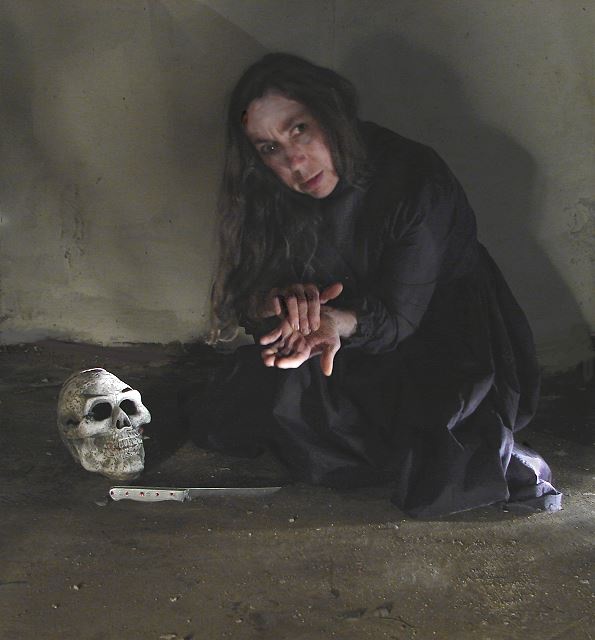
Showing posts with label Shakespeare. Show all posts

Thursday, March 14, 2013

Book Review - Shakespeare's Macbeth


I dare do all that may become a man; Who dares do more, is none” is Macbeth’s response to his wife when she challenges him to kill his sovereign. Macbeth’s response, among other things, suggests that when people try to overreach their position, it leads to failure; to be a man one must fulfill one’s role and obligations and nothing more. To do more is to fail.

The same could be said of books. Books that attempt to accomplish more than the purpose of their writing often end neither succeeding to attain the ‘vaulted ambition’ (read the play for clarity) nor the original intended end. Books, and men, should know their role.

Shakespeare’s Macbeth, by Leland Ryken, is a book that cannot be accused of overstepping its purpose. Crossway’s Christian Guides to the Classics series aims to help the intimidated or unfamiliar reader in their pursuit of reading classic literature. This guide accomplishes that.

Interestingly, in fulfilling its intended mandate, this small but potent work attains more; I think it is helpful for those beyond the scope of its appointed audience. As a secondary school English teacher who teaches Macbeth several times a year, I found this guide helpful and thus suggest that teachers will similarly find this guide useful.

Readers who are interested in reading this classic Shakespearean tragedy, whether they find this genre daunting or they feel they need some extra help, will find that this guide will assuage their fears and bolster their confidence. In particular, I think this educational tool would benefit students significantly. And the more experienced reader, perhaps familiar with the play or even responsible to teach it to others, will also find this book valuable.

Aside from the compelling and intriguing insights of its acclaimed writer, this guide is largely successful due to its format.

The book includes an introduction to Shakespeare, the play itself, and the context in which it was written. These features, along with the Plot Summary section for each scene, are suited to help those who approach the Bard’s work with imperceptible trepidation or unabashed trembling. The uninitiated reader will find these helpful as well.

The Commentary section along with the For Reflection or Discussion section will aid those involved in the study of Macbeth including both teachers and student. In Ryken’s apt analysis and explanations I found interesting tidbits of knowledge that I will use as I teach the play, but that I also found these nuggets delightful in and of themselves. Ryken’s expositions of scenes and acts are concise without being meagre. This keeps the guide short and useful.

Finally, in the margin on almost every page are points of interest, many of which pertain and speak to the Christian worldview. As a Christian educator in a public school system, I found these excursions refreshing and edifying. Placing this massive literary accomplishment in the context of the Kingdom of God sets this work apart from most other introductory material on this play.

I recommend this book to those who inwardly cower at the thought of reading something from Shakespeare yet recognize that this incredible playwright cannot be ignored. I recommend this book for the willing reader who desires a steadying arm on the journey into this wonderful tragedy. I recommend this reader for both teachers and students who will encounter the ‘Scottish Play’ in their course of study.

Monday, January 30, 2012

Interacting with literature


I'm looking forward to a series of posts by Carolyn Weber, entitled I Read Dead People, that she describes as such:
In this upcoming series, I would like to examine a handful of examples from literary greats, and consider how they challenge and inform our faith walk. The list need not be limited to Christian writers, or overtly Christian topics. I have found that to be irrelevant in the long run, as everything I have ever read, and continue to read, regardless of cultural or spiritual context or background, still speaks to me in some way of the human condition, our need for redemption, and most powerfully, the glory of God.
 You can follow this series by visiting her site regularly: Pressing Save: Reading, Writing, and Living the Word Eternal. She can also be found on Twitter: @CarolynWeber and @PressingSave .


In light of anticipating Weber's series on interacting with literature, I thought I would collect and present my blog posts in which I have reflected on classic literature that I was reading. The posts are listed under the author who's literature I interacted with.


Dumas:
http://quercuscalliprinos.blogspot.com/2011/10/we-believe-were-much-mre-unhappy.html


Dostoyevsky:
http://quercuscalliprinos.blogspot.com/2011/11/grotesque.html

http://quercuscalliprinos.blogspot.com/2011/11/all-ways-are-thine.html

http://quercuscalliprinos.blogspot.com/2011/11/pre-piperian-christian-hedonism.html

http://quercuscalliprinos.blogspot.com/2011/11/dostoyevsky-on-repentance.html

http://quercuscalliprinos.blogspot.com/2011/07/engage-to-read.html

http://quercuscalliprinos.blogspot.com/2011/06/packer-on-dostoyevsky.html


Shelley:
http://quercuscalliprinos.blogspot.com/2011/05/despair-guilt-and-remorse-in.html


Goethe:
http://quercuscalliprinos.blogspot.com/2010/01/from-faust-by-goethe.html


Donne:
http://quercuscalliprinos.blogspot.com/2009/11/john-donne-holy-sonnets-xv.html


Steinbeck:
http://quercuscalliprinos.blogspot.com/2011/06/perfect-among-mornings.html

http://quercuscalliprinos.blogspot.com/2011/06/detatchment-of-god.html


Tolstoy:
http://quercuscalliprinos.blogspot.com/2011/07/loss-of-our-wealth.html

http://quercuscalliprinos.blogspot.com/2011/07/i-never-regretted-anything.html

http://quercuscalliprinos.blogspot.com/2011/06/packer-on-dostoyevsky.html

http://quercuscalliprinos.blogspot.com/2010/10/from-leo-tolstoys-short-story-death-of.html


Shakespeare:
http://quercuscalliprinos.blogspot.com/2011/06/macbeth-and-preacher.html

http://quercuscalliprinos.blogspot.com/2011/01/shakespeare-on-stuff_16.html

http://quercuscalliprinos.blogspot.com/2010/07/what-will-these-hands-neer-be-clean.html

http://quercuscalliprinos.blogspot.com/2010/04/shakespeare-and-burroughs.html

http://quercuscalliprinos.blogspot.com/2011/05/shakespeare-and-psalm-46.html


Solzhenitsyn:
http://quercuscalliprinos.blogspot.com/2009/05/quoting-solzhenitsyn.html

Thursday, June 16, 2011

Macbeth and the Preacher

Macbeth:
To-morrow, and to-morrow, and to-morrow,
Creeps in this petty pace from day to day,
To the last syllable of recorded time;
And all our yesterdays have lighted fools
The way to dusty death. Out, out, brief candle!
Life's but a walking shadow, a poor player,
That struts and frets his hour upon the stage,
And then is heard no more. It is a tale
Told by an idiot, full of sound and fury,
Signifying nothing.

The Preacher:
Vanity of vanities, says the Preacher,
vanity of vanities! All is vanity.
What does man gain by all the toil
at which he toils under the sun?
A generation goes, and a generation comes,
but the earth remains forever.
The sun rises, and the sun goes down,
and hastens to the place where it rises.
The wind blows to the south
and goes around to the north;
around and around goes the wind,
and on its circuits the wind returns.
All streams run to the sea,
but the sea is not full;
to the place where the streams flow,
there they flow again.
All things are full of weariness;
a man cannot utter it;
the eye is not satisfied with seeing,
nor the ear filled with hearing.
What has been is what will be,
and what has been done is what will be done,
and there is nothing new under the sun.
Is there a thing of which it is said,
“See, this is new”?
It has been already
in the ages before us.
There is no remembrance of former things,
nor will there be any remembrance
of later things yet to be
among those who come after.
(Ecclesiastes 1:1-11 ESV)

Sunday, May 1, 2011

Shakespeare and Psalm 46

From Miscellanies:

A few curious facts to consider:

  • The Authorized Version was first published 400 years ago, in 1611.

  • In 1611 William Shakespeare was 46 years old.

  • In the AV translation of Psalm 46 …

    • … the 46th word from the top is translated “shake” (v. 3)

    • … the 46th word from the bottom is translated “spear” (v. 9)

It is highly doubtful this was pulled off by Shakespeare himself. But perhaps this was the work of a sneaky translator or editor? Perhaps this acknowledges Shakespeare’s literary influence on the AV translators? Or perhaps this is just a mere coincidence of great statistical proportion? We will probably never know.

Thursday, January 20, 2011

Solomon's Solidarity with Shakespeare

Macbeth, in Shakespeare's famous tragedy of the same name, becomes aware of the futility of life as his world begins to crumble around him. He has lost his wife to an apparent suicidal act. His conscience is seared with cruel acts of murder and treason. His newly acquired kingdom is under an attack lead by some who are highly motivated by revenge. He speaks,

To-morrow, and to-morrow, and to-morrow,
Creeps in this petty pace from day to day
To the last syllable of recorded time,
And all our yesterdays have lighted fools
The way to dusty death. Out, out, brief candle!
Life's but a walking shadow, a poor player
That struts and frets his hour upon the stage
Told by an idiot, full of sound and fury,
Signifying nothing. (V, v, 19-24)

This soliloquy reminded me of Solomon's writings in Ecclesiastes. For example, "For who knows what is good for man while he lives the few days of his vain life, which he passes like a shadow?" (Ecc. 6:12) The metaphor of life being a shadow images what both authors are getting at. Similarly, Solomon also touches upon the idea of life amounting to nothing: "As he came from his mother's womb he shall go again, naked as he came, and shall take nothing for his toil that he may carry away in his hand." (Ecc. 5:15)

It seems that both writers shared similar sentiments about life's futility.

Albert Mohler, president of Southern Baptist Theological Seminary, speaks to life and it's supposed futility: "The backdrop of eternity puts the span of human life into perspective. Our time on earth is short, but eternity dignifies time even as it reminds us of our finitude." (Mohler, R. Albert. For the Fame of God's Name: Essays in Honor of John Piper. Wheaton, IL: Crossway, 2010. Print. 364)

Eternity, won and bought by Christ for us, dignifies life! Yes, we are finite. Yes, life is a vapor, a shadow. But Christ's work, wrought on the cross and resulting in eternal life, removes futility from the equation. More than that, the cross infuses life with meaning and purpose beyond our understanding or imagination. For those who are perishing, life is futile. But for those who are being saved, life is full of meaning.

Sunday, January 16, 2011

Shakespeare on stuff

With this there grows
In my most ill-composed affection such
A stanchless avarice that, were I king,
I should cut off the nobles for their lands,
Desire his jewels and this other's house:
And my more-having would be as a sauce
To make me hunger more; that I should forge
Quarrels unjust against the good and loyal,
Destroying them for wealth.

(Macbeth, Act IV, Scene iii, Lines 76-84, emphasis mine)

In the excerpt above, Malcolm, the son of the traitorously slain King Duncan and rightful heir to the throne, is describing what his reign would be like should he ascend to the throne. He is not speaking honestly. He is testing Macduff to be sure that Macduff is trustworthy and a true friend.

When the class I teach studied this act of Shakespeare's famous tragedy, these lines jumped out at me. Shakespeare has shown great insight to the nature of wealth accumulation; the things of this world do not satisfy. The "more-having" would not sate the desire for things, rather, it would, as Malcolm puts it, "make me hunger more."

An interesting reminder from the Bard of the fleetingness of possessions. There is only one truly satisfying thing: God!

Monday, July 5, 2010

What, will these hands ne'er be clean?


From Shakespeare's play Macbeth:

ACT V

SCENE I. Dunsinane. Ante-room in the castle.

Enter a Doctor of Physic and a Waiting-Gentlewoman

Doctor
I have two nights watched with you, but can perceive
no truth in your report. When was it she last walked?
Gentlewoman
Since his majesty went into the field, I have seen
her rise from her bed, throw her night-gown upon
her, unlock her closet, take forth paper, fold it,
write upon't, read it, afterwards seal it, and again
return to bed; yet all this while in a most fast sleep.
Doctor
A great perturbation in nature, to receive at once
the benefit of sleep, and do the effects of
watching! In this slumbery agitation, besides her
walking and other actual performances, what, at any
time, have you heard her say?
Gentlewoman
That, sir, which I will not report after her.
Doctor
You may to me: and 'tis most meet you should.
Gentlewoman
Neither to you nor any one; having no witness to
confirm my speech.
Enter LADY MACBETH, with a taper
Lo you, here she comes! This is her very guise;
and, upon my life, fast asleep. Observe her; stand close.
Doctor
How came she by that light?
Gentlewoman
Why, it stood by her: she has light by her
continually; 'tis her command.
Doctor
You see, her eyes are open.
Gentlewoman
Ay, but their sense is shut.
Doctor
What is it she does now? Look, how she rubs her hands.
Gentlewoman
It is an accustomed action with her, to seem thus
washing her hands: I have known her continue in
this a quarter of an hour.
LADY MACBETH
Yet here's a spot.
Doctor
Hark! she speaks: I will set down what comes from
her, to satisfy my remembrance the more strongly.
LADY MACBETH
Out, damned spot! out, I say!--One: two: why,
then, 'tis time to do't.--Hell is murky!--Fie, my
lord, fie! a soldier, and afeard? What need we
fear who knows it, when none can call our power to
account?--Yet who would have thought the old man
to have had so much blood in him.
Doctor
Do you mark that?
LADY MACBETH
The thane of Fife had a wife: where is she now?--
What, will these hands ne'er be clean?--No more o'
that, my lord, no more o' that: you mar all with
this starting.
Doctor
Go to, go to; you have known what you should not.
Gentlewoman
She has spoke what she should not, I am sure of
that: heaven knows what she has known.
LADY MACBETH
Here's the smell of the blood still: all the
perfumes of Arabia will not sweeten this little
hand. Oh, oh, oh!
Doctor
What a sigh is there! The heart is sorely charged.
Gentlewoman
I would not have such a heart in my bosom for the
dignity of the whole body.
Doctor
Well, well, well,--
Gentlewoman
Pray God it be, sir.
Doctor
This disease is beyond my practise: yet I have known
those which have walked in their sleep who have died
holily in their beds.
LADY MACBETH
Wash your hands, put on your nightgown; look not so
pale.--I tell you yet again, Banquo's buried; he
cannot come out on's grave.
Doctor
Even so?
LADY MACBETH
To bed, to bed! there's knocking at the gate:
come, come, come, come, give me your hand. What's
done cannot be undone.--To bed, to bed, to bed!
Exit

Doctor
Will she go now to bed?
Gentlewoman
Directly.
Doctor
Foul whisperings are abroad: unnatural deeds
Do breed unnatural troubles: infected minds
To their deaf pillows will discharge their secrets:
More needs she the divine than the physician.
God, God forgive us all! Look after her;
Remove from her the means of all annoyance,
And still keep eyes upon her. So, good night:
My mind she has mated, and amazed my sight.
I think, but dare not speak.
Gentlewoman
Good night, good doctor.
Exeunt

In this scene, Lady Macbeth's guilt for her participation in the killing of the king, as well as her knowledge of other murders resulting from her husband's ascent to the throne of Scotland, are causing her to have hallucinations. The famous line "Out, damned spot! out, I say!" is in reference to the blood she dreams is on her hands from helping murder her sovereign. To her, the blood, which no amount of washing can remove, is a sign of the gnawing, haunting guilt that plagues her. For the queen of Scotland, blood represents her guilt and sinfulness.

Contrarily, for the Christian blood is a sure sign of our righteousness and our good standing with our Sovereign. Romans 5:9 states, "Since, therefore, we have now been justified by his blood, much more shall we be saved by him from the wrath of God." The blood of Jesus is evidence that our guilt has been removed and our consciences are cleared. Unlike Lady Macbeth, the Christians only hope is in the fact that the blood cannot be removed.

1. What can wash away my sin?
Nothing but the blood of Jesus.
What can make me whole again?
Nothing but the blood of Jesus.
Refrain:
O precious is the flow
that makes me white as snow;
no other fount I know;
nothing but the blood of Jesus.

2. For my pardon this I see:
nothing but the blood of Jesus.
For my cleansing this my plea:
nothing but the blood of Jesus.
(Refrain)

3. Nothing can for sin atone:
nothing but the blood of Jesus.
Naught of good that I have done:
nothing but the blood of Jesus.
(Refrain)

4. This is all my hope and peace:
nothing but the blood of Jesus.
This is all my righteousness:
nothing but the blood of Jesus.
(Refrain)

Thursday, April 22, 2010

Shakespeare and Burroughs


Having just finished studying Romeo & Juliet with my grade 10 English class, we were watching the Luhrmann video rendition of it [the one that stars DiCaprio]. One of the soliloquies reminded me of a book I read last year; The Rare Jewel of Christian Contentment by Jeremiah Burroughs.

The soliloquy under consideration is spoken by Friar Laurence in Act III Scene iii. Romeo has just killed Juliet's cousin Tybalt. Realizing that he has further jeopardized their tenuous marriage, Romeo has a 'hissy fit' in Friar Laurence's cell and prepares to kill himself; or feigns doing so.

Friar Laurence, appalled by his actions, verbally accosts him:
Hold thy desperate hand:
Art thou a man? thy form cries out thou art:
Thy tears are womanish; thy wild acts denote

The unreasonable fury of a beast:
Unseemly woman in a seeming man!
After chastising the young Montague, Friar Laurence tries to help Romeo percieve his plight with a different perspective:
What, rouse thee, man! thy Juliet is alive,
For whose dear sake thou wast but lately dead;

There art thou happy: Tybalt would kill thee,

But thou slew'st Tybalt; there are thou happy too:

The law that threaten'd death becomes thy friend

And turns it to exile; there art thou happy:

He follows this perspective altering dialogue with the words that reminded me of Burrough's classic work on contentment:
A pack of blessings lights up upon thy back;
Happiness courts thee in her best array;

But, like a misbehaved and sullen wench,

Thou pout'st upon thy fortune and thy love:

Take heed, take heed, for such die miserable.

Specifically, this reminded me of a point Burroughs makes while discussing what Christian contentment consisted of: "It is not so much the removing of the affliction that is upon us as the changing of the affliction, the metamorphosing of the affliction, so that it is quite turned and changed into something else."

Friar Laurence is trying not to remove Romeo's affliction, but rather he is trying to metamorphisize his affliction into something else. For the Christian, this is a task for grace, "There is a power of grace to turn this affliction into good; it takes away the sting and poison of it." Burroughs goes on to say,
Oh, take heed you do not speak in a scornful way of the ways of God; grace has the power to turn afflictions into mercies. Two men may have the same affliction; to one it shall be as gall and wormwood, yet it shall be wine and honey and delightfulness and joy and advantage and riches to the other. This is the mystery of contentment, not so much by removing the evil, as by metamorphosing the evil, by changing the evil into good.