Showing posts with label the blood of Christ. Show all posts

Sunday, October 10, 2010

Winslow on the blood!

Even with the current surge in cross-centered, gospel-centered, and Christ-centered teaching, it still seems to me that we don't hear about "the blood" with the same frequency or fervor with which they used to talk about it. Here is part of a devotional that I read this morning.


From Morning Thoughts by Octavius Winslow:


"Forasmuch as you know that you were not redeemed with corruptible things,as silver and gold, from your vain conversation received by tradition fromyour father; but with the precious blood of Christ, as of a lamb withoutblemish and without spot." 1 Peter 1:18, 19
WHAT a powerful motive does this truth supply to a daily and unreserved consecration of ourselves to the Lord! If, under the old economy, the utensil or the garment touched with blood was sacred and solemn, how much more the soul washed in the heart's blood of Christ! When the king of Israel, in the heat of battle, and in the agony of thirst, cried for water, and some of his attendants procured it for him at the hazard of their lives, the God-fearing and magnanimous monarch refused to taste it, because it was the price of blood! but "poured it out before the Lord." Christian soldier! it was not at the risk of His life, but more—it was by the sacrifice of His life that your Lord and Savior procured your redemption, and brought the waters of salvation, all living and sparkling from the throne of God, to your lips. You are the price of blood! "bought with a price." Will you not, then, glorify God in our soul, body, and substance, which are His? will you not pour it all out before the Lord—presenting it as a living sacrifice upon the altar flowing with the lifeblood of God's own Son?

Monday, July 5, 2010

What, will these hands ne'er be clean?


From Shakespeare's play Macbeth:

ACT V

SCENE I. Dunsinane. Ante-room in the castle.

Enter a Doctor of Physic and a Waiting-Gentlewoman

Doctor
I have two nights watched with you, but can perceive
no truth in your report. When was it she last walked?
Gentlewoman
Since his majesty went into the field, I have seen
her rise from her bed, throw her night-gown upon
her, unlock her closet, take forth paper, fold it,
write upon't, read it, afterwards seal it, and again
return to bed; yet all this while in a most fast sleep.
Doctor
A great perturbation in nature, to receive at once
the benefit of sleep, and do the effects of
watching! In this slumbery agitation, besides her
walking and other actual performances, what, at any
time, have you heard her say?
Gentlewoman
That, sir, which I will not report after her.
Doctor
You may to me: and 'tis most meet you should.
Gentlewoman
Neither to you nor any one; having no witness to
confirm my speech.
Enter LADY MACBETH, with a taper
Lo you, here she comes! This is her very guise;
and, upon my life, fast asleep. Observe her; stand close.
Doctor
How came she by that light?
Gentlewoman
Why, it stood by her: she has light by her
continually; 'tis her command.
Doctor
You see, her eyes are open.
Gentlewoman
Ay, but their sense is shut.
Doctor
What is it she does now? Look, how she rubs her hands.
Gentlewoman
It is an accustomed action with her, to seem thus
washing her hands: I have known her continue in
this a quarter of an hour.
LADY MACBETH
Yet here's a spot.
Doctor
Hark! she speaks: I will set down what comes from
her, to satisfy my remembrance the more strongly.
LADY MACBETH
Out, damned spot! out, I say!--One: two: why,
then, 'tis time to do't.--Hell is murky!--Fie, my
lord, fie! a soldier, and afeard? What need we
fear who knows it, when none can call our power to
account?--Yet who would have thought the old man
to have had so much blood in him.
Doctor
Do you mark that?
LADY MACBETH
The thane of Fife had a wife: where is she now?--
What, will these hands ne'er be clean?--No more o'
that, my lord, no more o' that: you mar all with
this starting.
Doctor
Go to, go to; you have known what you should not.
Gentlewoman
She has spoke what she should not, I am sure of
that: heaven knows what she has known.
LADY MACBETH
Here's the smell of the blood still: all the
perfumes of Arabia will not sweeten this little
hand. Oh, oh, oh!
Doctor
What a sigh is there! The heart is sorely charged.
Gentlewoman
I would not have such a heart in my bosom for the
dignity of the whole body.
Doctor
Well, well, well,--
Gentlewoman
Pray God it be, sir.
Doctor
This disease is beyond my practise: yet I have known
those which have walked in their sleep who have died
holily in their beds.
LADY MACBETH
Wash your hands, put on your nightgown; look not so
pale.--I tell you yet again, Banquo's buried; he
cannot come out on's grave.
Doctor
Even so?
LADY MACBETH
To bed, to bed! there's knocking at the gate:
come, come, come, come, give me your hand. What's
done cannot be undone.--To bed, to bed, to bed!
Exit

Doctor
Will she go now to bed?
Gentlewoman
Directly.
Doctor
Foul whisperings are abroad: unnatural deeds
Do breed unnatural troubles: infected minds
To their deaf pillows will discharge their secrets:
More needs she the divine than the physician.
God, God forgive us all! Look after her;
Remove from her the means of all annoyance,
And still keep eyes upon her. So, good night:
My mind she has mated, and amazed my sight.
I think, but dare not speak.
Gentlewoman
Good night, good doctor.
Exeunt

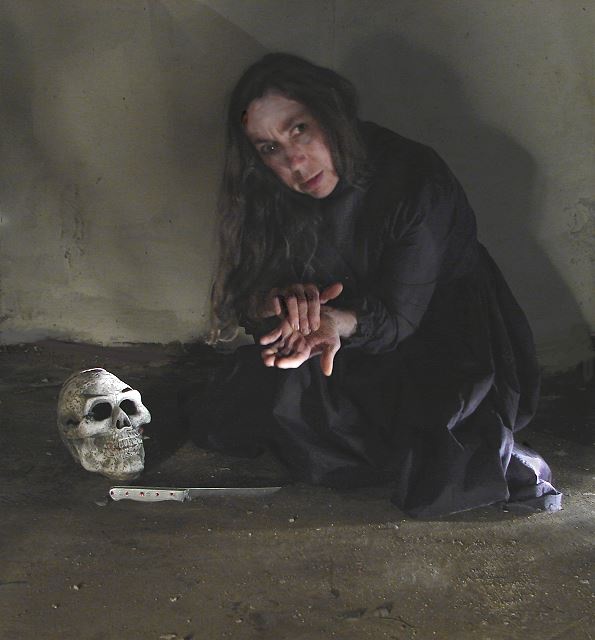
In this scene, Lady Macbeth's guilt for her participation in the killing of the king, as well as her knowledge of other murders resulting from her husband's ascent to the throne of Scotland, are causing her to have hallucinations. The famous line "Out, damned spot! out, I say!" is in reference to the blood she dreams is on her hands from helping murder her sovereign. To her, the blood, which no amount of washing can remove, is a sign of the gnawing, haunting guilt that plagues her. For the queen of Scotland, blood represents her guilt and sinfulness.

Contrarily, for the Christian blood is a sure sign of our righteousness and our good standing with our Sovereign. Romans 5:9 states, "Since, therefore, we have now been justified by his blood, much more shall we be saved by him from the wrath of God." The blood of Jesus is evidence that our guilt has been removed and our consciences are cleared. Unlike Lady Macbeth, the Christians only hope is in the fact that the blood cannot be removed.

1. What can wash away my sin?
Nothing but the blood of Jesus.
What can make me whole again?
Nothing but the blood of Jesus.
Refrain:
O precious is the flow
that makes me white as snow;
no other fount I know;
nothing but the blood of Jesus.

2. For my pardon this I see:
nothing but the blood of Jesus.
For my cleansing this my plea:
nothing but the blood of Jesus.
(Refrain)

3. Nothing can for sin atone:
nothing but the blood of Jesus.
Naught of good that I have done:
nothing but the blood of Jesus.
(Refrain)

4. This is all my hope and peace:
nothing but the blood of Jesus.
This is all my righteousness:
nothing but the blood of Jesus.
(Refrain)

Friday, November 13, 2009

Why the shedding of blood?

Building on Chris' post directly below this one, consider this verse:
Hebrews 9:22 - Indeed, under the law almost everything is purified with blood, and without the shedding of blood there is no forgiveness of sins.

I have no disagreement with what this verse seems to state in such an obvious manner. But I have often wondered; why? Why does there need to be the shedding of blood for the remission of sins. Why not the picking of flowers or the climbing of mountains? Why can't something much simpler, and let's be honest, less bloody, be sufficient to remove our sins? And more specifically, why did Jesus have to shed His blood for the remission of my sins?

The path I used to take when considering this went along the lines of attributing the reasons for Jesus' shedding of His blood to the following of a pre-set pattern. Since the Levitical rites had been implemented by God via Moses, Jesus was obligated to follow the pattern and sacrifice Himself for the forgiveness of our sins. But consider Hebrews 9:23:
Thus it was necessary for the copies of the heavenly things to be purified with these rites, but the heavenly things themselves with better sacrifices than these.

This seems to clearly suggest that it was the Levitical rites that were following a pattern; and so the idea of sacrifice precedes Moses as the prototypical method as opposed to following Moses as a copy.

John Murray puts it like this:
Hence the necessity for the blood offerings of the Levitical economy arose from the fact that the exemplar after which they were fashioned was a blood offering, the transcendent blood offering by which the heavenly things were purified. The necessity of blood-shedding on the Levitical ordinance is simply a necessity arising from the necessity of blood-shedding in the higher realm of the heavenly. (Murray, John. Redemption Accomplished and applied. Grand Rapids: Eerdmans Publishing. 1955. p15)


So, whatever the reason there must be shedding of blood, it is independent of the Levitical rites for the Levitical economy is contingent on the heavenly economy.

Monday, July 20, 2009

His blood be upon us

In The Gospel of Matthew we get an account of the Passion of Christ which includes the releasing of Barrabas and the crowds bargaining with Pilate over the fate of Christ. Consider this section of the 27th chapter:

15 Now at the feast the governor was accustomed to release for the crowd any one prisoner whom they wanted. 16 And they had then a notorious prisoner called Barabbas. 17 So when they had gathered, Pilate said to them, “Whom do you want me to release for you: Barabbas, or Jesus who is called Christ?” 18 For he knew that it was out of envy that they had delivered him up. 19 Besides, while he was sitting on the judgment seat, his wife sent word to him, “Have nothing to do with that righteous man, for I have suffered much because of him today in a dream.” 20 Now the chief priests and the elders persuaded the crowd to ask for Barabbas and destroy Jesus. 21 The governor again said to them, “Which of the two do you want me to release for you?” And they said, “Barabbas.” 22 Pilate said to them, “Then what shall I do with Jesus who is called Christ?” They all said, “Let him be crucified!” 23 And he said, “Why, what evil has he done?” But they shouted all the more, “Let him be crucified!” 24 So when Pilate saw that he was gaining nothing, but rather that a riot was beginning, he took water and washed his hands before the crowd, saying, “I am innocent of this man's blood; see to it yourselves.” 25 And all the people answered, “His blood be on us and on our children!” 26 Then he released for them Barabbas, and having scourged Jesus, delivered him to be crucified. (emphasis mine)
The response by the crowd, "His blood be upon us and our children", jumped out at me. Originally, the crowd cried this so that Pilate would free them to crucify Christ. And I realize that I was in that crowd seeking to crucify the Son of God.

But , by the grace of God, I still cry that His blood be upon me and my children. Now, however, I do not seek His blood in order to crucify Him, but rather to receive the forgiveness from sins. His blood was once a sign of my guilt; his blood was on me indicating my responsibility in His death. Now His blood covers me freeing me from the power of sin and its consequences.